 Tool bags
 Tool Storage
 Made in USA
 Tool Bags By Trade
 Everyday Carry
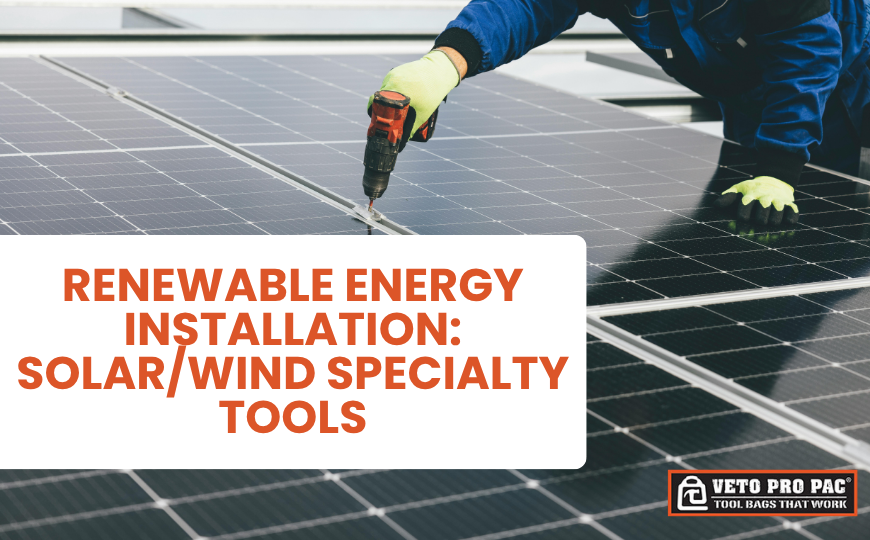
The residential electrician shows up to wire a rooftop solar array with a standard service bag. Twenty minutes into the job, he’s made three trips to his truck for tools that should have been obvious: DC-rated meter, torque wrench for module clamps, insulated tools rated for higher voltage strings. By lunch, he’s realized this isn’t modified electrical work—it’s a distinct specialization requiring purpose-built equipment.
Renewable energy installation occupies unique territory between traditional electrical trades and specialized industrial work. You’re working at heights with fall protection gear, handling DC voltages that behave differently than AC systems, torquing connections to manufacturer specifications that determine twenty-five-year warranties, and commissioning systems where measurement precision affects long-term revenue calculations.
Standard electrical tools cover perhaps sixty percent of renewable energy work. The remaining forty percent—the difference between competent installation and professional-grade work—requires specialized equipment. This guide breaks down the exact tools, safety integration requirements, and bag organization strategies that separate solar/wind installers from electricians trying to adapt.
Why Renewable Energy Demands Specialty Tools
Solar and wind installations impose requirements absent from conventional electrical work, driving tool selection beyond standard trade equipment.
DC voltage characteristics change the game:
Direct current doesn’t cross zero like alternating current. Arc flash incidents in DC systems sustain longer, creating more severe hazards. This affects everything from meter ratings to disconnect mechanisms. Your standard AC-rated multimeter might technically measure DC voltage, but it’s not designed for the sustained fault currents possible in large PV arrays.
Solar strings commonly operate at 300-600V DC, with some commercial systems reaching 1000V+. These voltages demand CAT III or CAT IV rated meters designed specifically for DC measurement. The $80 meter that handles residential AC perfectly will give false readings or fail catastrophically in high-voltage DC applications.
Torque specifications determine system longevity:
Module mounting hardware, grounding connections, and DC combiner terminations all specify exact torque values. Under-torqued connections create high-resistance joints that heat up, degrading over decades. Over-torqued connections damage components or strip threads, creating future maintenance nightmares.
Unlike typical residential work where “tight enough” suffices, renewable installations include warranty requirements specifying documented torque compliance. You need calibrated torque tools and the discipline to use them on every connection. This isn’t perfectionism—it’s contractual requirement.
Height access and fall protection integration:
Rooftop solar and utility-scale wind work happen at elevations requiring fall protection. Your tool bag becomes part of a managed load calculation. Every tool must be secured to prevent dropped object hazards. Standard bags don’t integrate with harness systems, carabiners, or tool tethers effectively.
The organizational approach that works on ground-level electrical panels fails when you’re harnessed on a 6/12 pitch roof or hanging in a bucket truck. Tools need accessibility while meeting fall protection requirements. Specialty bags designed for height work solve problems residential electricians never encounter.
Environmental exposure affects equipment selection:
Solar installations expose tools to full sun, temperature extremes, and weather. Meters that overheat and shut down, plastic-bodied tools that become brittle in UV exposure, batteries that discharge in cold—these failures don’t happen in climate-controlled buildings.
Wind installations add vibration, moisture, and offshore salt exposure in marine environments. Your tools take environmental abuse that destroys equipment not designed for outdoor industrial applications. Investing in ruggedized, weatherproof versions of standard tools isn’t luxury—it’s operational necessity.
Commissioning requirements demand measurement precision:
Unlike typical electrical work where “it works or it doesn’t,” renewable systems require precise performance verification. String voltage measurements, array current readings, and power output calculations determine whether systems meet contractual specifications.
A meter accurate to ±2% might suffice for troubleshooting residential circuits. For verifying that a 50kW solar array meets guaranteed production thresholds, you need ±0.5% accuracy or better. The measurement tools differentiate between acceptable variance and contractual failure.
Essential Specialty Tools for Solar Installation
Solar PV work requires additions to standard electrical tool kits—not complete replacement, but significant augmentation.
DC-Rated Electrical Testing Equipment
High-voltage DC multimeter (CAT III/IV rated):
Invest in meters specifically designed for DC solar work. Fluke 393 FC or equivalent provides the voltage range (1000V+ DC), accuracy, and safety ratings necessary for solar string measurement. These meters include features like peak voltage capture and insulation resistance testing that standard multimeters lack.
Budget: $400-600. This isn’t optional—using under-rated meters on high-voltage DC systems risks equipment destruction and personal injury. The meter must be rated for the maximum string voltage you’ll encounter, not just the nominal operating voltage.
Insulation resistance tester (megohmmeter):
Required for verifying that installed arrays don’t have ground faults before energizing. Measures insulation resistance between conductors and ground at test voltages (typically 500V or 1000V). This testing catches installation errors (damaged wire insulation, improper grounding) before they create arc flash hazards.
Models like the Fluke 1587 combine megohm testing with standard multimeter functions, reducing tool count. Expect $500-800 for reliable units. Some jurisdictions require insulation testing documentation before arrays can be energized—having the capability prevents subcontracting this work.
Clamp meter for DC current measurement:
String current verification during commissioning requires non-contact measurement. DC clamp meters (Fluke 355 or similar) measure current without breaking connections. This allows performance verification without system shutdown.
Standard AC-only clamp meters won’t work—DC measurement requires different Hall effect sensors. Budget $250-400. If you’re doing commercial-scale installations, the time saved in commissioning justifies cost immediately.
Non-contact voltage tester rated for DC:
Many standard tick testers work poorly or not at all on DC systems. Fluke LVD2 or equivalent provides reliable indication of energized DC conductors. Critical for verifying lockout/tagout before working on arrays.
This is life-safety equipment. DC arcs sustain differently than AC, making false negatives potentially fatal. Spend the $50-80 for DC-rated testers rather than trusting AC-only versions.
Torque Tools and Fastening Equipment
Beam-type torque wrench (10-150 in-lbs range):
Module mounting clamps, grounding lugs, and array hardware specify torques in this range. Beam-type torque wrenches maintain calibration better than clicker types and don’t require recalibration between uses. CDI or Precision Instruments models run $80-150.
Get comfortable reading beam deflection—it’s more precise than waiting for clicker types to release. Module manufacturers often provide torque specifications that vary by connection type; having a wrench that covers the full range prevents tool swapping.
Digital torque adapter (for verification):
High-value installations justify digital torque measurement for documentation. Adapters like the CDI Micro-Adjustable TorqControl provide ±2% accuracy and digital readout for quality records. Budget $200-300.
Not essential for every installation, but commercial projects requiring documentation or where warranty compliance needs verification benefit from digital precision. Some inspectors request torque documentation on larger arrays.
Impact driver with torque limiting function:
For volume work (large arrays with hundreds of mounting points), impact drivers with torque limiting prevent over-tightening while accelerating installation. DeWalt and Milwaukee both offer models with adjustable torque limiting.
Standard impact drivers risk over-torquing and damaging mounting rails or modules. Torque-limiting versions provide speed without risk. Budget $150-250 for quality units.
Module Handling and Positioning Equipment
Module lifting suction cups:
Rated suction systems (like Bohle Veribor) allow single-person module positioning on steep roofs. Four-cup systems handle standard 60-72 cell modules safely. This prevents module damage from grip pressure and reduces back strain.
Budget $200-300 for professional-grade sets. Cheaper suction cups fail unexpectedly—module drops cost thousands in replacement plus installation time. Get rated systems with pressure indicators showing secure attachment.
Ratchet strap sets (with edge protection):
Securing module stacks during rooftop staging requires straps that won’t damage module edges. Use ratchet straps with edge protectors designed for solar modules. Standard cargo straps without protection can crack module glass or frames under tension.
Sets of 4-6 straps with appropriate edge protection run $50-100. Essential for wind protection during installation and preventing module movement on sloped roofs.
Height Safety and Access Equipment
Full-body harness with tool attachment points:
Fall protection harnesses designed for work positioning include multiple D-rings for tool tethering. Standard construction harnesses often lack sufficient attachment points for tool management at height.
Budget $200-400 for harnesses meeting ANSI Z359.11 standards with work positioning capability. Your harness is your primary safety system—don’t compromise here.
Tool tethers and carabiners:
Every tool taken to height must be secured. Coiled tool tethers (Ergodyne Squids or equivalent) attach tools to harness, preventing drops. Budget $5-15 per tether; you’ll need 8-12 for comprehensive tool tethering.
Locking carabiners (rated for tool attachment, not just fall arrest) secure heavier tools and bags. Use different colors to distinguish tool tethers from fall protection components. Budget $50-100 for sufficient carabiner inventory.
Roof anchor and fall arrest equipment:
Temporary roof anchors designed for solar work provide fall protection attachment without penetrating roofing. Models like the Guardian Fall Protection anchors meet OSHA requirements and set up quickly.
Budget $150-300 per anchor. Commercial projects often require multiple anchors for 100% tie-off during transitions. This is non-negotiable safety equipment—you can’t install solar without fall protection compliance.
Wire Management and Installation Tools
PV wire stripping tools:
Standard wire strippers struggle with PV wire’s thick insulation and tinned copper conductors. Dedicated PV wire strippers (like the Weidmuller Stripax) handle 10-12 AWG PV wire efficiently without conductor damage.
Budget $40-80. The time savings on projects involving hundreds of wire terminations justifies specialty strippers immediately. Damaged conductors from inadequate stripping create long-term reliability problems.
MC4 connector crimping tool:
MC4 connectors are standard for module interconnection. While cheap MC4 crimpers exist, professional versions (Weidmuller Multicrimp or PV Tools MC4 crimper) create reliable connections that survive 25+ year installations.
Budget $150-300 for quality tools. Bad crimps create high-resistance connections that heat, degrade, and eventually fail. In arrays with hundreds of connections, quality crimping isn’t optional.
Cable cutters rated for PV wire:
PV wire’s tinned conductors and UV-resistant insulation require sharp cutters designed for the material. Klein or Knipex cable cutters rated for copper up to 2/0 AWG handle PV wire without excessive force.
Budget $60-120. Dull cutters create compression before cutting, damaging conductors and creating installation problems during termination.
Essential Specialty Tools for Wind Installation
Wind work shares some solar tools while requiring additional specialized equipment for tower access and turbine-specific tasks.
Tower Climbing and Rescue Equipment
Wind-specific fall arrest system:
Wind tower climbing requires vertical fall arrest systems—typically cable or rail-mounted shuttle devices that travel with the climber. These differ significantly from standard construction fall protection.
Tower owners often provide climbing systems, but installers should have personal systems for flexibility and ensuring proper fit. Budget $800-1,200 for complete climbing harness and shuttle system meeting wind industry standards.
Rescue kit and descent device:
Wind towers require rescue capability—if someone is injured at height, they can’t simply be lowered by crane. Self-rescue or assisted rescue equipment is mandatory.
Rescue kits including descent devices, evacuation harnesses, and rescue rope run $500-1,000. OSHA and turbine manufacturer requirements make this non-optional. Many states require rescue training and equipped rescue capability before tower access.
Turbine-Specific Installation Tools
Large torque multipliers:
Tower bolting and turbine component fasteners specify torques in hundreds or thousands of foot-pounds. Manual torque wrenches can’t achieve these values—torque multipliers provide mechanical advantage.
Hydraulic torque wrenches (Enerpac or equivalent) or gear-driven multipliers (Norbar, CDI) reach specified torque values. These tools are project-specific—typically rented rather than owned unless you’re doing frequent wind work. Rental costs $200-500 weekly depending on capacity.
High-voltage testing equipment:
Wind turbines operate at voltages from 690V to 35kV depending on collection system design. Testing requires specialized high-voltage meters and insulation testers rated for these levels.
This equipment overlaps with utility-scale solar work. Expect $1,000-3,000 for meters capable of safely measuring and testing wind turbine voltage levels. Often this work requires utility certification, positioning it beyond typical electrical contractor scope.
Hydraulic and Mechanical Tools
Hydraulic crimping tools:
Large wind turbine cables (often 2/0 to 500MCM) require hydraulic crimping. Battery-powered hydraulic crimpers (Milwaukee, Greenlee) handle these sizes reliably.
Budget $2,000-4,000 for battery-powered units. For contractors doing frequent wind work, the investment pays off. Occasional work might justify renting ($150-300 daily).
Specialized pulley and rigging equipment:
Cable pulling through towers and raising equipment to nacelle level requires rated rigging. Block and tackle systems, rope grabs, and lifting slings specific to wind work differ from standard construction rigging.
This equipment is project-specific and often supplied by the turbine installer/contractor. Electricians doing balance-of-plant work typically don’t need comprehensive rigging sets, but should understand load ratings and safe practices.
Safety Integration: Tools as Part of Fall Protection System
Renewable work at height changes how tools integrate into your safety system.
Tool tethering discipline:
Every tool going to height must be tethered before ascending. Dropped tools from 30-foot roofs or 200-foot wind towers create fatal hazards and expensive damage.
Develop checklist habit: tool goes in bag → tether attaches to tool → tool comes out of bag at height. No exceptions. The 30 seconds spent tethering beats the consequences of dropped tools.
Use appropriate tether strength: small hand tools on 2-lb rated tethers, larger tools and bags on 5-10 lb rated tethers. Factor dynamic forces—a dropped 3-lb tool generates significant force during tether arrest.
Load-rated tool bags:
Bags taken to height must be rated as part of fall protection load. Many standard tool bags aren’t rated for overhead lifting or as suspended loads.
Veto Pro Pac bags aren’t specifically rated for overhead lifting, but their construction quality handles incidental suspension through proper attachment. For dedicated height work, consider bags with integrated lifting points and load ratings (like those from Buckingham or Klein’s line safety bags). Budget $200-400.
Alternatively, place your standard bag inside a rated bucket or bag that provides lifting capability while protecting contents.
Tool organization for single-hand access:
At height while tied off, you often have one hand managing position/safety and one hand for tools. Organization must allow single-handed tool retrieval.
This means:
- Magnetic wristbands for fasteners/small parts
- Tools in retention loops, not buried in pockets
- Frequently-used tools in outer positions
- Heavier tools tethered but accessible without extensive searching
Practice tool access while simulating working positions. If you can’t grab and secure a tool one-handed, reorganize.
Weight management for extended height work:
Carrying 40-50 lbs of tools up ladder systems to wind nacelles or climbing roof pitches repeatedly creates fatigue that compromises safety. Renewable work demands tool load discipline.
Bring only what the specific task requires. Stage tools at height in manageable groups rather than carrying comprehensive capability. Accept multiple trips if it means maintaining safe load levels.
Tool Bag Organization for Renewable Energy Work
Renewable installations require modified organization approaches compared to standard electrical work.
The Two-Bag System: Ground vs. Height
Ground bag (comprehensive):
Keep full tool inventory in ground-level bag staged at work area. This contains everything needed for the project but isn’t carried to height. Organization can be standard electrical contractor setup.
Staging location: near ladder access, protected from weather, visible from work positions. This is your supply depot.
Height bag (task-specific):
Small bag (20-25 tools maximum) that goes to the height for specific tasks. Module installation might need: impact driver, torque wrench, MC4 crimper, wire strippers, meter, multitool. That’s it.
Return to ground bag when changing tasks. Rooftop conduit work needs different tools than module installation—swap height bag contents rather than carrying universal capability everywhere.
The Veto Pro Pac Tech Pac Backpack Tool Bag excels for renewable energy height work. Its compact design keeps tool count disciplined while maintaining organization through elastic loops and compartments. The backpack format distributes weight properly for ladder climbing and roof work, and the nylon construction withstands the UV exposure and weather that destroys standard bags within months. For contractors doing regular rooftop solar work, it’s purpose-built for exactly this application.
Alternative recommended height bags: small backpack-style tool bags (10-15L capacity) with tether points, or dedicated fall protection tool bags. Budget $80-200 for non-Veto options.
Task-Based Zoning for Solar Work
Organize around job phases rather than tool types:
Module mounting zone:
- Impact driver with torque limiting
- Beam torque wrench
- Suction cup handles
- Measuring tape
- Module mounting hardware in labeled containers
Electrical termination zone:
- PV wire strippers
- MC4 crimpers and connectors
- Multimeter
- Wire nuts and ferrules
- Cable ties and markers
Testing and commissioning zone:
- DC multimeter
- Clamp meter
- Insulation tester
- Non-contact voltage tester
- Commissioning documentation
Emergency and safety zone:
- First aid supplies
- Harness inspection equipment
- Backup tethers
- Emergency communication (two-way radio)
This organization mirrors workflow progression and allows quick assembly of height bags for specific phases.
Environmental Protection for Equipment
Weatherproof storage systems:
Tools stored on rooftops or at outdoor wind sites need protection from elements. Weatherproof cases (Pelican, Apache) prevent moisture damage to meters and electronics.
Budget $50-200 depending on capacity needs. Meters worth hundreds of dollars justify protective cases absolutely.
Temperature management for batteries:
Lithium tool batteries perform poorly below freezing. Winter solar installations require battery warming strategies—keeping batteries in insulated pockets, rotating cold and warm batteries, storing overnight in heated locations.
Cold weather reduces battery capacity by 20-40%. Plan for shorter runtime and carry additional batteries in cold weather installations.
UV protection for bags and straps:
Direct sun exposure degrades synthetic materials. Tool bags and fall protection equipment experiencing full sun daily deteriorate faster than same equipment used indoors.
Inspect UV-exposed equipment more frequently. Replace bags showing material degradation (fading, brittleness, reduced flexibility) before failure. Ballistic nylon (like Veto Pro Pac uses) resists UV better than standard nylon, but no material is immune to sun damage with continuous exposure.
Tool Acquisition Strategy for Entering Renewable Energy
Transitioning into renewable work doesn’t require buying everything simultaneously—strategic acquisition allows gradual investment.
Phase 1: Immediate Additions (Budget: $1,000-1,500)
Start with tools that distinguish renewable work from standard electrical:
- DC-rated multimeter (CAT III minimum): $400-600
- Beam torque wrench (10-150 in-lb): $80-150
- PV wire strippers: $40-80
- MC4 crimping tool: $150-300
- Non-contact voltage tester (DC-rated): $50-80
- Basic tool tethers and carabiners: $100-150
- Module suction cups: $200-300
This provides core capability for residential solar work. You can complete installations with these additions to standard electrical tools.
Phase 2: Professional Refinement (Budget: $1,500-2,500)
Add capabilities that increase efficiency and expand project scale:
- Insulation resistance tester: $500-800
- DC clamp meter: $250-400
- Digital torque adapter: $200-300
- Impact driver with torque limiting: $150-250
- Fall protection harness (work positioning): $200-400
- Height-rated tool bag: $150-250
- Weatherproof meter case: $100-150
With Phase 2 complete, you handle commercial-scale solar professionally and meet most inspection/commissioning requirements independently.
Phase 3: Specialization and Wind Entry (Budget: $3,000-5,000+)
For contractors moving into utility-scale solar or wind work:
- High-voltage meter (1000V+ DC): $600-1,000
- Tower climbing fall arrest system: $800-1,200
- Rescue kit and descent device: $500-1,000
- Hydraulic crimping tool: $2,000-4,000
- Comprehensive fall protection anchor system: $500-1,000
Phase 3 represents commitment to renewable energy as primary specialization. Many contractors rent Phase 3 equipment initially, purchasing only after contract volume justifies ownership.
Rental vs. Purchase Decision Framework
Consider rental when:
- Tool use frequency under 20 days annually
- Equipment requires calibration maintenance exceeding ownership cost benefit
- Technology evolves rapidly (commissioning equipment)
- Project-specific tools not applicable to general renewable work
Consider purchase when:
- Tool use exceeds 30 days annually
- Equipment critical for rapid job completion (can’t wait for rental availability)
- Rental costs over two years exceed purchase price
- Tool differentiates your capabilities from competitors
Renewable Energy Tool Maintenance Requirements
Specialized tools require specialized care—maintenance approaches differ from standard electrical equipment.
Torque tool calibration:
Beam-type torque wrenches maintain calibration well but should be verified annually against known standards. Digital torque adapters require calibration every 12 months or 5,000 cycles (whichever comes first).
Calibration costs $50-150 per tool. Some manufacturers (CDI, Precision Instruments) offer annual calibration programs. Without calibration, you can’t document torque compliance for warranty purposes.
Meter verification and calibration:
DC meters and insulation testers drift over time and with heavy use. Annual calibration ensures accuracy within specifications. Fluke and other manufacturers provide calibration services ($150-300 per meter).
For contractors without calibration budget, cross-check meters against known references quarterly. Significant variance indicates calibration need.
Fall protection equipment inspection:
OSHA requires fall protection equipment inspection before each use and formal inspection annually. Harnesses, lanyards, and anchors showing damage, wear, or degradation must be removed from service immediately.
Develop pre-use inspection routine: Check webbing for cuts/abrasion, hardware for distortion/corrosion, stitching for breakage. Document annual formal inspections. Replace questionable equipment—your life depends on it.
Cleaning and storage:
Tools used outdoors accumulate dirt, moisture, and contaminants that accelerate wear. Institute end-of-project cleaning: wipe tools, blow out debris, inspect for damage.
Store tools in controlled environment when possible. Meters and electronics in climate-controlled locations, mechanical tools in dry storage. UV-exposed bags in covered areas between projects.
Renewable Energy Installation Tool FAQs
Can I use my standard electrical meters for solar work?
For small residential arrays under 300V, possibly—but it’s not recommended. DC voltage behaves differently than AC, and standard meters aren’t designed for sustained DC measurement. For commercial arrays and anything over 300V DC, you absolutely need DC-rated meters with appropriate CAT ratings. Using under-rated meters risks equipment damage and personal injury. Budget $400-600 for proper DC meters.
What’s the minimum tool investment to start doing residential solar installations?
Plan $1,000-1,500 for essential additions to your standard electrical tools: DC multimeter, torque wrench, PV wire strippers, MC4 crimper, and basic fall protection additions. This handles typical residential rooftop arrays. As you take on larger or commercial projects, expand from there. Don’t skimp on safety equipment—fall protection and properly rated meters are non-negotiable.
Do I need different tools for wind vs. solar installations?
There’s significant overlap (DC meters, torque tools, fall protection) but wind adds tower climbing equipment, rescue capability, and often higher-voltage testing equipment. If you’re primarily doing solar, skip wind-specific tools until you have confirmed wind projects. Tower climbing and rescue equipment ($1,500-2,500) represents substantial investment for occasional use.
How do I organize tools when working on steep roofs?
Use a task-specific height bag (20-25 tools max) with everything tethered. Stage your comprehensive ground bag at ladder access. Make trips to swap tools rather than carrying everything. Ensure your height bag has secure closure and attachment points. Magnetic wristbands help manage small parts. Practice accessing tools one-handed since you’ll often need one hand for balance/safety.
What tools should I rent vs. buy for occasional renewable work?
Rent infrequently-used specialty items: large torque multipliers, high-voltage testing equipment for wind, hydraulic crimpers for large cable. Buy items you’ll use on every project: DC meters, torque wrenches, PV wire strippers, MC4 crimpers, fall protection. If you’re doing less than one project monthly, consider renting even mid-tier items until volume justifies purchase.
How important is tool quality for renewable energy work?
Extremely important. These installations carry 25-year warranties with your work quality determining long-term performance. Cheap torque wrenches that don’t hold calibration, inaccurate meters, unreliable crimpers—all create future failures and liability. Budget for quality from reputable manufacturers. Your Veto Pro Pac bag should hold professional-grade tools, not harbor Harbor Freight compromises. The installation quality your tools enable determines whether you get referral work or warranty callbacks.
Renewable energy installation represents electrical trade evolution, not revolution. Your core electrical knowledge applies, but the specialized nature of DC systems, height work requirements, and long-term performance obligations demand purpose-built tools beyond standard electrical equipment.
The contractor showing up to solar work with adapted residential tools struggles. The professional carrying DC-rated meters, calibrated torque equipment, and integrated fall protection executes efficiently while meeting warranty and safety requirements that define renewable installation quality.
Start with Phase 1 tool additions—$1,000-1,500 buys core capability for residential solar. Expand systematically as project volume and scale justify investment. Within two years of committed renewable work, your tool inventory will have grown substantially, but so will your capability and market positioning.
The renewable energy market isn’t slowing. Contractors with proper tools, safety discipline, and professional approach capture premium work while competitors struggle with adapted equipment. Your tool investment isn’t cost—it’s competitive positioning in the fastest-growing electrical specialization.