
 Tool bags
 Tool Storage
 Made in USA
 Tool Bags By Trade
 Everyday Carry
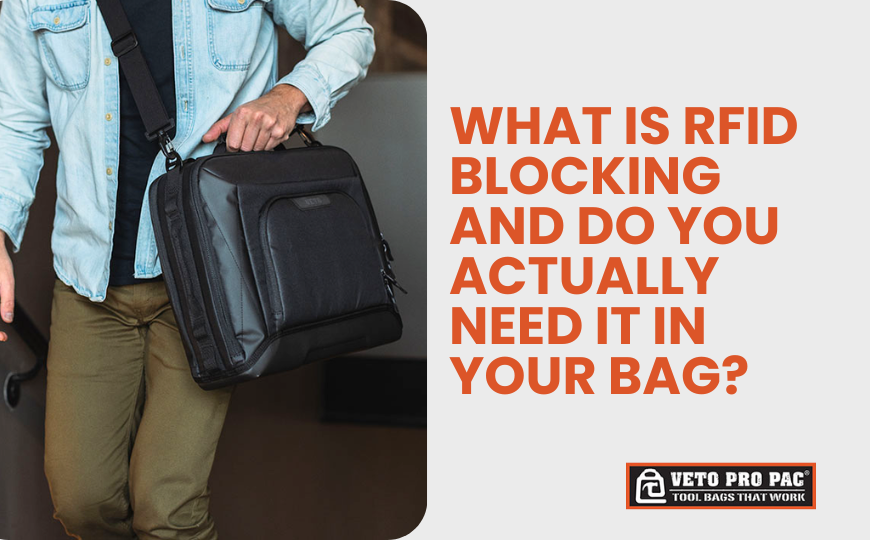
Quick Answer: RFID blocking prevents wireless theft of data from contactless credit cards and passports. The actual risk is extremely low; documented cases of real-world RFID theft are rare. You need RFID protection if you frequently travel internationally, carry multiple contactless cards, or visit high-density tourist areas. You don’t need it for domestic travel or everyday use.
RFID-blocking bags saturate the travel gear market. Manufacturers position it as essential security. Travel influencers declare it mandatory. Security experts debate whether the threat is real or manufactured.
The technology works. The question is whether you’re solving an actual problem or buying protection against a mostly theoretical risk. This guide breaks down exactly what RFID blocking does, how contactless theft works, the documented evidence of actual risk, and when protection makes sense versus when it’s security theater.
What Is RFID Technology and How Does It Work?
RFID (Radio Frequency Identification) transmits data wirelessly between a chip and a reader using electromagnetic fields.
Your contactless cards contain:
- RFID chip (smaller than a grain of rice)
- Antenna (the metallic pattern visible through some cards)
- Stored data (card number, expiration date, sometimes name)
How contactless payment works:
- You hold your card near a payment terminal (within 1-4 inches)
- Terminal emits radio frequency signal
- Your card’s chip powers on from that signal (no battery needed)
- Card transmits payment data to terminal
- Transaction completes in under one second
This same technology appears in:
- Contactless credit and debit cards (Visa PayWave, Mastercard PayPass)
- Transit cards (metro systems, buses)
- Electronic passports (e-passports with chips)
- Building access cards
- Hotel room keys
The convenience creates the vulnerability. If a payment terminal can read your card through your wallet from 1-4 inches away, could a criminal’s hidden reader do the same thing?
How RFID Skimming Theoretically Works
RFID skimming (stealing card data wirelessly without physical contact) requires specific equipment and proximity.
The theoretical attack:
A thief carries a concealed RFID reader (available online for $50-300) in a backpack or bag. They position themselves close to you in a crowded space, subway, tourist attraction, festival. The reader attempts to communicate with RFID chips in your wallet or bag. If successful, it captures transmitted data: card number, expiration date, and sometimes cardholder name.
The captured data limitations:
Modern contactless cards transmit limited information. They do NOT transmit:
- CVV security code (the 3-4 digits on the back)
- Your PIN
- Your billing address
- Your full name (usually just first initial and last name)
Without the CVV, stolen data can’t be used for online purchases (the most common form of credit card fraud). The data could theoretically be used for in-person contactless payments, but this requires additional steps.
Technical limitations that reduce risk:
Distance requirement: Contactless cards require 1-4 inch proximity to readers. Some high-powered readers claim 6-8 inch range, but signal strength drops dramatically with distance. Reading through multiple layers (your wallet, your bag, your clothing) further reduces range.
Multiple cards create interference: If you carry 3-4 contactless cards together, they interfere with each other’s signals. Readers often can’t isolate a single card’s data when multiple chips are present.
Transaction limits exist: Most contactless payments have per-transaction limits ($50-250 depending on country and bank) and daily limits. A thief can’t drain your account through wireless skimming.
Encryption has improved: Newer contactless cards (issued 2018+) use dynamic encryption that changes with each transaction. Even if data is captured, it can’t be reused. It’s valid for only one transaction and expires within seconds.
The Actual Risk: What the Data Shows
Security researchers demonstrate RFID skimming in controlled environments. Real-world theft is a different question.
Documented cases of RFID skimming theft:
Comprehensive search of law enforcement reports, fraud statistics, and security research reveals virtually zero documented cases of actual RFID skimming fraud in the wild. The theoretical vulnerability exists. The practical exploitation is nearly nonexistent.
Why the low incidence?
Traditional fraud is easier and more profitable. Credit card skimming at gas pumps, phishing emails, and data breaches at retailers steal card data more efficiently and in larger quantities than one-card-at-a-time contactless skimming in crowds.
The effort-to-reward ratio is terrible. A thief must acquire RFID reading equipment ($50-300), position themselves within inches of targets in crowded spaces (increasing detection risk), capture data that lacks CVV codes (limiting usability), and execute contactless transactions in person (creating evidence trail). Traditional fraud methods provide better returns with lower risk.
Banks detect unusual patterns immediately. A contactless transaction in a foreign country or multiple rapid small purchases trigger fraud alerts. Banks shut down cards within hours, limiting thief’s window.
What security researchers say:
Organizations like the FTC and consumer protection agencies acknowledge RFID technology creates theoretical vulnerability but note the lack of real-world fraud cases. Their position: RFID blocking provides peace of mind but isn’t addressing a widespread threat.
The risk is low but nonzero. In specific circumstances (international travel to areas with high organized crime, carrying newly-issued passports, or frequent exposure to dense crowds), the theoretical risk becomes worth mitigating.
When You Actually Need RFID Blocking
The decision depends on specific circumstances, not universal recommendations.
Strong case for RFID protection:
International travel: E-passports contain RFID chips storing biographical data and photo. While passport data is encrypted and reading requires the optically-scanned information from the data page, RFID blocking prevents any possibility of unauthorized scanning. Carry passport in RFID-blocking sleeve or pocket when traveling internationally.
High-density tourist areas: Barcelona, Rome, Paris, and other destinations with high rates of organized pickpocketing see criminals testing various theft techniques. RFID protection adds a layer of defense in environments where opportunistic theft is common.
Multiple contactless cards: If you carry 5+ contactless credit cards, transit cards, and access badges, RFID blocking simplifies security. One protected wallet/bag covers everything rather than worrying about which specific cards might be vulnerable.
New technology adopters: Freshly-issued contactless cards and new e-passports use the latest RFID standards. While these include better security, they’re also the primary targets for criminals testing new skimming techniques.
Peace of mind value: If concern about RFID theft creates travel anxiety, the protection is worth it for psychological comfort alone. Security isn’t purely about mathematical risk, perceived safety affects travel experience.
Weak case for RFID protection (probably don’t need it):
Domestic travel in developed countries: RFID skimming has essentially zero documented cases in US, Canada, UK, Australia, or Western Europe domestic travel. Traditional theft (physical pickpocketing) remains the overwhelmingly dominant risk.
Everyday local use: Walking around your home city with contactless cards in your wallet doesn’t require RFID blocking. The theoretical risk exists but is dwarfed by dozens of higher-probability threats you already ignore (phone theft, traditional pickpocketing, data breaches).
Single-card carriers: If you carry one credit card and it’s in a traditional leather wallet in your front pocket, the multiple layers of material already reduce RFID reading range to near-zero. Adding RFID blocking provides minimal additional protection.
Older magnetic stripe cards: If your cards require physical swiping and don’t have contactless capability (no radio wave symbol on the card), RFID skimming is impossible. You don’t need protection for non-RFID cards.
What to Look for in RFID-Blocking Bags
If you’ve determined RFID protection makes sense for your situation, quality matters.
Effective RFID blocking uses metal-infused fabric or metal mesh that creates a Faraday cage, a shield that blocks electromagnetic signals. Quality implementation includes:
Complete coverage: RFID material must surround the protected compartment entirely. Gaps or seams in the protective material create vulnerabilities. Check that zippers use special design or overlapping material to prevent signal leakage.
Appropriate thickness: Thicker RFID-blocking material provides better protection but adds weight and reduces pocket flexibility. Balance protection level with usability, ultra-thin RFID fabric may not block all frequencies.
Dedicated compartments: RFID protection works best in designated pockets. Bags claiming “RFID-blocking construction throughout” often provide inconsistent protection. Look for clearly labeled RFID pockets for passports and cards.
Testing and certification: Reputable manufacturers test RFID-blocking effectiveness and provide specifications. Look for claims like “blocks 13.56 MHz RFID signals” (the frequency used by most contactless cards and passports).
What matters more than RFID blocking:
Physical security: Lockable zippers, slash-resistant materials, and hidden pockets prevent traditional theft, a far more common threat than RFID skimming. A bag with excellent physical security and no RFID blocking protects better than RFID-blocking material in an easily-opened bag.
Durability: RFID-blocking fabric wears out over time. Cheap implementations fail after 6-12 months of regular use. Quality construction (reinforced stitching, durable materials) maintains protection long-term.
Organization: Quick access to cards and passports reduces time spent with wallet or bag open in public, a much higher theft risk than wireless skimming. Good organization is security.
RFID Blocking: The Veto Pro Pac Approach
The Norwalk + 20L Backpack and Norwalk + 18L Messenger include dedicated RFID-blocking pockets designed specifically for passports and cards. This focused approach provides protection where it matters while keeping the rest of the bag flexible and lightweight.
Why Veto’s approach works better:
RFID protection where you need it. Dedicated passport/card pocket with complete RFID blocking. The rest of the bag remains standard construction, no unnecessary weight or expense protecting items that don’t need shielding.
Security through construction quality. YKK zippers that resist forced entry, ballistic nylon that resists slashing, and reinforced stress points prevent the 99% of theft that’s physical, not electronic. RFID blocking handles the 1% theoretical risk.
Professional-grade durability. Veto’s tool bag heritage means RFID-blocking material is integrated into construction designed for years of heavy use. The protection doesn’t degrade after six months like cheaper travel bags.
The Norwalk series positions RFID blocking appropriately: a useful security feature for travelers who need it, integrated into bags designed around more important priorities like durability, organization, and physical security.
For digital nomads and frequent international travelers, the Norwalk + 20L provides dedicated electronics organization plus RFID protection. For urban commuters and business travelers, the Norwalk + 18L Messenger offers professional appearance with integrated security features.
Decision Framework: Do You Need RFID Blocking?
You should invest in RFID-blocking bags or sleeves if:
- You travel internationally 3+ times per year
- You visit destinations with high organized crime rates
- You carry an e-passport (all US passports issued since 2007)
- You have 3+ contactless credit cards
- Peace of mind about electronic security is important to you
- You’re already buying a new travel bag (incremental cost is minimal)
You can skip RFID protection if:
- You travel domestically only
- Your cards use magnetic stripe (no contactless capability)
- You carry 1-2 cards in a traditional thick wallet
- You prioritize other security features (slash-proof material, locking zippers)
- The added cost bothers you and you prefer addressing higher-probability risks
The middle ground: Buy a quality bag based on durability, organization, and comfort. If it includes RFID blocking, great. If not, add a $10 RFID-blocking sleeve for your passport. Don’t let RFID be the primary purchasing decision, it’s a nice-to-have feature, not a must-have security essential.
RFID Blocking FAQ
How do I know if my cards have RFID chips?
Look for a sideways WiFi symbol (four curved lines) on your card. This indicates contactless/RFID capability. You can also test by trying to make a contactless payment, hold your card near a payment terminal without inserting or swiping. If it works, your card has RFID. Most credit cards issued after 2019 include contactless capability.
Can RFID blocking damage my cards?
No. RFID blocking simply prevents radio waves from reaching the chip. It’s passive shielding, not active interference. Your cards function normally when removed from RFID-protected storage. The technology is the same as a Faraday cage used to protect sensitive electronics.
Do I need RFID blocking for my phone?
No. Your smartphone’s NFC (Near Field Communication) used for Apple Pay and Google Pay has different security than contactless cards. Phone-based payments require biometric authentication (fingerprint or face scan) and generate one-time transaction codes. The phone must be unlocked and the payment app actively engaged, wireless skimming can’t access this data.
Does aluminum foil actually block RFID signals?
Yes, but inconsistently. Aluminum foil creates a Faraday cage if you completely wrap items with no gaps. Any holes or tears allow signals through. Commercial RFID-blocking products provide more reliable protection than DIY aluminum foil solutions. For emergency protection (lost your RFID sleeve), aluminum foil works temporarily.
Will RFID blocking interfere with contactless payment when I want to use it?
You must remove cards from RFID-protected storage to make contactless payments. This is the intended function, blocking prevents both unauthorized AND authorized reading. Some bags use quick-access RFID pockets that allow fast card retrieval when you need to make legitimate payments.
How long does RFID-blocking material last?
Quality RFID-blocking fabric lasts 5-10 years with normal use. Cheap implementations degrade within 1-2 years as the metal-infused material wears thin or separates. Durability correlates with overall bag construction quality, a well-made bag with RFID protection maintains that protection long-term.
Are there different levels of RFID protection?
Yes. Basic RFID blocking stops 13.56 MHz signals (most credit cards and passports). Advanced protection blocks wider frequency ranges including 125 KHz (some access cards) and UHF frequencies (inventory tracking tags). For travel purposes, 13.56 MHz protection suffices, this is what contactless payment cards use.
Can RFID readers really work from several feet away?
No, despite some marketing claims. Standard contactless cards require 1-4 inches between card and reader. High-powered readers might reach 6-8 inches under ideal conditions (no obstacles, perfectly aligned). Claims of multi-foot reading distances either refer to different RFID technology (not payment cards) or are exaggerated. Realistic threat range: touching-distance to very close proximity.
RFID blocking protects against a real vulnerability with extremely low real-world exploitation rates. The technology works. The threat exists in theory more than practice.
For frequent international travelers, especially those visiting high-tourism destinations in Europe, RFID protection provides inexpensive peace of mind. For domestic travelers or those carrying single contactless cards, the protection is optional.
The decision shouldn’t drive your bag purchase. Choose bags based on durability, organization, comfort, and physical security features. If the bag includes RFID blocking, consider it a useful bonus. If it doesn’t, a $10 passport sleeve provides targeted protection for the items most worth protecting.
The Veto perspective: Security comes from quality construction, thoughtful design, and durable materials, not from marketing claims about theoretical threats. RFID blocking is one security feature among many. YKK zippers that resist forced entry, ballistic nylon that resists slashing, and structured organization that makes theft difficult matter more than electromagnetic shielding.
Build security through layers. Physical theft prevention, quality materials, and smart travel habits provide more protection than any single technological feature. RFID blocking fits into this layered approach, useful for some travelers, unnecessary for others, but never a substitute for fundamental security practices.