
 Tool bags
 Tool Storage
 Made in USA
 Tool Bags By Trade
 Everyday Carry
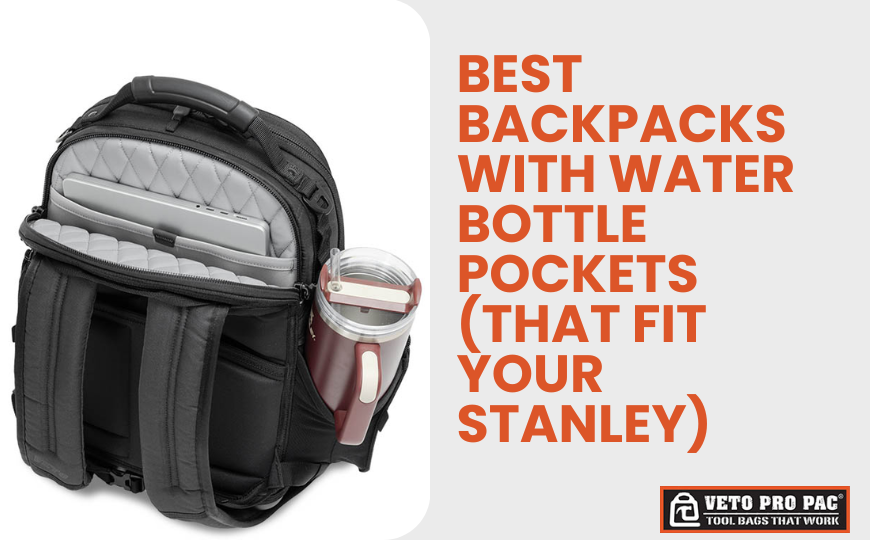
Quick Answer: The best backpacks for 40 oz Stanley bottles feature deep, stretchy side pockets with secure closures. Look for pockets measuring 5+ inches deep with elastic or compression straps. Magnetic zippered pockets (like the Norwalk+ 20L) provide the most secure hold while allowing one-handed access. Standard mesh pockets work for bottles without handles but struggle with handled tumblers.
Stanleys aren’t exactly cheap, so the last thing anyone wants is for it to be rattling around loose in your backpack’s side pocket, threatening to fall out every time you lean over. Or worse, the side pockets rip because you’ve been angling in a water bottle that almost fits because you trusted the backpack’s website description.
Best Backpacks for Stanley Bottles: Quick Comparison
Best Overall: Norwalk+ 20L Backpack
- Fits up to 40 oz water bottles
- Unique magnetic zippered pockets for one-handed operation
- Water-resistant base
- Professional-grade YKK zippers and reinforced construction
- 20L capacity ideal for daily commuting
- Best for: Anyone who wants secure, convenient bottle access with professional durability
Best for Light Travelers: Patagonia Black Hole 32L
- 32L volume for travel and outdoor use
- 100% recycled materials
- Durable stretch mesh pockets, though some reviews report these rip over time.
Best for Daypackers: North Face Recon
- 30L capacity for textbooks and laptop
- Side compression strap retention system
- FlexVent comfort for heavy loads
Best for Durability: Topo Designs Rover Pack
- Adjustable side water bottle pockets
- Fair Wear certified production,
- 100% recycled nylon
- A multitude of colorblock designs
Best for Students: Osprey Proxima 30
- Fits 16-inch laptops
- Dual panel compression straps
- Internal main compartment with tablet and document sleeves
Best Budget Option: Under Armour Hustle 6.0
- Affordable price point
- Separate compartment for shoes/laundry
- Top grab handle
- Water resistant
What Makes a Water Bottle Pocket Actually Work
Five characteristics separate functional large-bottle pockets from marketing claims.
Deep construction. The pocket must envelope the bottle to at least its midpoint (minimum 9 inches for 40 oz bottles). This provides stability and prevents the weight from pulling the bottle out when you move. Pockets measuring 5-6 inches deep work for 20 oz bottles. They’re inadequate for 40 oz tumblers.
Stretch material or gusseted design. The pocket needs to expand from 3 inches (small water bottle) to 6+ inches (handled tumbler) without tearing, losing shape, or permanently deforming. High-quality stretch mesh accomplishes this through fabric elasticity. Gusseted pockets use folded panels that expand when needed and compress when holding smaller bottles.
Active retention. Elastic alone isn’t enough. The best pockets add compression straps, drawcord closures, or zipper systems that actively secure bottles rather than relying solely on material tension.
Reinforced stress points. The connection between pocket and backpack experiences significant load when carrying 2-3 pound bottles. Cheap construction fails at these seams within months. Look for bar-tack stitching and reinforced attachment points.
Accessibility design. One-handed bottle removal and insertion. Side-angle approach beats rear-facing pockets. The opening should be wide enough to guide the bottle in without looking, but secure enough that it won’t fall out when empty.
The Magnetic Advantage: Norwalk+ 20L Backpack
Veto Pro Pac spent 20+ years solving organization problems for professional tradespeople. When electricians need tools accessible instantly while working on ladders, traditional pocket designs fail.
The same principles apply to their daily travel bag line.
The Norwalk+ 20L features unique zippered magnetic side pockets designed specifically for 40 oz bottles. The magnetic system provides three advantages over traditional elastic mesh.
Secure closure with one-handed operation. Magnets guide the zipper closed automatically. Insert your Stanley bottle. Release it. The pocket secures itself. No fumbling with compression straps or drawcords. No worrying whether you actually closed it properly.
Weather protection. Mesh exposes bottles to rain, dust, and damage. The Norwalk+’s zippered pockets shield contents from the elements. Your Stanley stays clean during commutes through bad weather or dusty trail hikes.
Implementation details matter here. Veto uses YKK zippers (the same grade that professional outdoor gear requires). The magnetic closure points are positioned to guide the zipper pull without manual alignment. The pocket’s reinforced base prevents bottom-out wear that destroys cheaper bags.
Beyond the water bottle pockets, the Norwalk+ applies professional-grade construction throughout.
The thermoformed base provides rigid structure that maintains the bag’s shape even when packed light. Cheaper backpacks collapse and become shapeless when partially full, making organization impossible.
Recycled materials meet environmental responsibility without compromising durability. The ballistic nylon construction resists abrasion and tearing through years of daily use.
The padded laptop compartment (holds up to 15-inch machines) uses impact-resistant thermoforming to protect devices from drops and impacts. Not foam padding that compresses over time. Structural protection.
Anti-scratch protection throughout the interior prevents keys, zippers, and metal objects from damaging phones, tablets, and other electronics. Reflective accents provide visibility for night commuting or early morning gym trips.
The spacious 20-liter interior balances capacity for full day use (laptop, change of clothes, lunch, gym gear) without excessive bulk that makes the bag unwieldy on public transit or in crowded spaces.
The Norwalk+ handles multiple use cases:
- Gym commuting (work clothes + workout gear + laptop + 40 oz water bottle)
- Digital nomad tech organization (laptop + accessories + daily essentials)
- Hiking and outdoor recreation (hydration + first aid + layers)
- One-bag travel for weekend trips (3 days of clothing + toiletries + tech)
- Daily commuting (laptop + lunch + essentials + generous water capacity)
Water Bottle Pocket Maintenance and Longevity
Pockets wear out faster than the rest of your backpack. Constant stress from bottle insertion, removal, and weight takes its toll.
Mesh pocket care: Elastic mesh degrades over time, especially when repeatedly stretched to maximum capacity. Rotating between different-sized bottles (instead of always using your largest bottle) extends pocket life. Hand-washing prevents elastic breakdown from machine agitation.
Zippered pocket care: YKK zippers (like those on the Norwalk+) last 5-10 years with minimal maintenance. Keep the zipper track clear of dirt and debris. Lubricate annually with zipper wax or beeswax if the zipper becomes stiff.
Compression strap care: Check strap attachment points quarterly for loosening. Tighten any loose stitching immediately to prevent complete separation. Replace worn straps before they fail completely.
Signs your pocket is failing:
- Bottles fall out when you bend over
- Mesh has visible tears or holes
- Elastic no longer grips smaller bottles
- Zipper doesn’t close smoothly
- Compression straps won’t tighten
- Bottle sits too high in pocket (mesh has stretched)
Quality construction maintains water bottle pocket integrity for 5+ years. Budget backpacks often fail in 6-12 months with daily large-bottle use.
Backpack Water Bottle Pocket FAQ
Will a 40 oz Stanley fit in standard backpack water bottle pockets?
Sometimes. Standard pockets designed for traditional plastic bottles measure 3-4 inches in diameter and 7-8 inches deep. A 40 oz Stanley Quencher’s body might fit if the mesh is stretchy enough, but the handle makes it significantly wider. Pockets specifically designed for large bottles (with deep construction of 9+ inches and stretch or gusseted design) accommodate 40 oz Stanleys reliably. Test before buying if possible.
Do magnetic water bottle pockets work better than mesh?
Yes, for bottles over 32 oz. Magnetic zippered pockets (like the Norwalk+ design) provide three advantages: weather protection, one-handed operation, and consistent retention that doesn’t degrade over time. Mesh pockets stretch to accommodate large bottles initially but lose tension after months of use. The magnetic system maintains secure closure indefinitely. For bottles under 20 oz, mesh simplicity may be preferable to zipper complexity.
Can I fit two 40 oz bottles in backpack side pockets?
Only if the backpack has pockets on both sides and both are designed for large bottles. Most backpacks with dual side pockets accommodate one large bottle (40 oz) on one side and smaller items (umbrella, tripod) on the other. Carrying two 40 oz bottles (5.4 pounds when full) creates significant weight and balance issues. Consider a backpack with internal bottle storage or a hydration bladder compartment for dual large-bottle capacity.
What’s better for hiking: water bottle pocket or hydration bladder?
Different use cases. Water bottle pockets (especially magnetic zippered designs) allow you to monitor water levels, refill easily at streams with filtration, and share water with others. You can also swap to warm beverages in cold weather.
Hydration bladders provide hands-free drinking through a tube, ideal for trail running or activities where stopping to grab a bottle breaks rhythm. Many backpacks support both systems. Carry a 40 oz Stanley in the pocket for camp and around-town use, plus a bladder for actual hiking.
Do handled tumblers work in backpack side pockets?
Depends on the pocket design and handle configuration. Tumblers with side handles (Stanley Quencher, Owala tumbler) fit best in zippered pockets, gusseted pockets, and high-stretch mesh pockets. They’re very tight in standard mesh pockets. The handle prevents the tumbler from sitting flush against the bag and adds bulk. Some users remove the handle for better pocket fit, though this reduces carrying convenience.
How do I keep my water bottle from falling out while running or cycling?
Choose backpacks with active retention systems rather than passive mesh. Compression straps cinch over the bottle opening. Zippered pockets close completely around the bottle. Drawcord closures tighten the pocket top.
For high-movement activities, also consider internal bottle storage or hydration bladders designed specifically for running packs. External side pockets work well for walking and commuting but can be problematic for running and cycling.
Will insulated bottles sweat through backpack pockets?
Quality insulated bottles (Stanley, Yeti, Hydro Flask) are double-walled with vacuum insulation that prevents exterior condensation. If your bottle is sweating, either the vacuum seal is compromised or it’s not truly insulated.
Zippered pockets provide some additional protection against moisture transfer to other bag contents. Mesh pockets allow any moisture to wick away from the bottle but can’t protect other items if the bottle does sweat. Single-wall metal bottles and plastic bottles do condensate significantly and shouldn’t be used in backpack pockets with electronics.
Can backpack water bottle pockets fit bottles larger than 40 oz?
Some can. Certain backpacks with exceptionally stretchy mesh pockets fit 64 oz Yeti Ramblers according to testing. These are exceptional cases (most pockets max out at 40 oz). Bottles above 40 oz (when full) create significant weight and balance issues in side pockets anyway. Consider internal storage or a hydration system for larger capacity needs.
Your water bottle shouldn’t be an afterthought stuffed in a pocket that wasn’t designed for it.
The best water bottle pocket matches your specific use case. Gym commuters need different features than hikers. Daily commuters have different priorities than weekend travelers. Students carrying textbooks need different capacity than digital nomads with laptops and cables.
But the core requirements remain constant: deep pockets (9+ inches), stretch or gusseted design, active retention, reinforced construction, and accessible placement. These fundamentals separate pockets that technically fit your Stanley from pockets that actually keep it secure.
Start with your specific bottle. Measure its height, diameter, and handle dimensions if applicable. Then test backpacks in person when possible, or choose models with verified large-bottle compatibility.
Your Stanley deserves a proper home, one that’s as well-engineered as the bottle itself.