 Tool bags
 Tool Storage
 Made in USA
 Tool Bags By Trade
 Everyday Carry

Your tool bags sit on a folding table at the back of your 10×10 booth. A hand-lettered sign propped against one reads “Quality Tools Since 2015.” Three attendees walk past without slowing down. The booth next to yours—a competitor with identical services—has a line of prospects waiting to talk.
The difference isn’t your work quality or pricing; it’s presentation. At trade shows, your tool bag display is a marketing asset that either builds credibility or broadcasts amateur hour. The gap between vendors who generate 50+ qualified leads and those who go home empty-handed often comes down to booth strategy, not business capability.
This guide breaks down professional tool bag display tactics that convert booth traffic into actual business, backed by ROI analysis from contractors who’ve cracked the trade show code.
Why Tool Bag Displays Matter More Than You Think
Trade show attendees make snap judgments. Research on exhibit effectiveness shows prospects decide whether to engage with a booth in 3-5 seconds of visual contact. Your tool bag display communicates professionalism, specialization, and attention to detail before you say a word.
The credibility calculation happens instantly:
A organized, well-maintained tool setup signals: “This contractor runs a tight operation. If their tools look this professional, imagine their job sites.” A cluttered or generic display suggests: “If they can’t organize a booth, how will they manage my project?”
Construction managers and facility directors—your target trade show audience—evaluate contractors constantly. They’re trained to spot operational red flags. Tool organization isn’t superficial; it’s a proxy for project management capability.
Beyond first impressions, a strategic display creates conversation opportunities. When prospects stop to examine a specialty tool or ask about organization systems, you’ve created an engagement window. The tool bag becomes an icebreaker that leads to business discussions naturally, rather than aggressive sales pitches that repel attendees.
The Three-Tier Display System That Drives Engagement
Professional exhibitors organize booth displays in visual layers that guide attendee attention progressively. Your tool bag setup should follow the same principle.
Tier 1: The Attention Magnet (Eye-Level Feature)
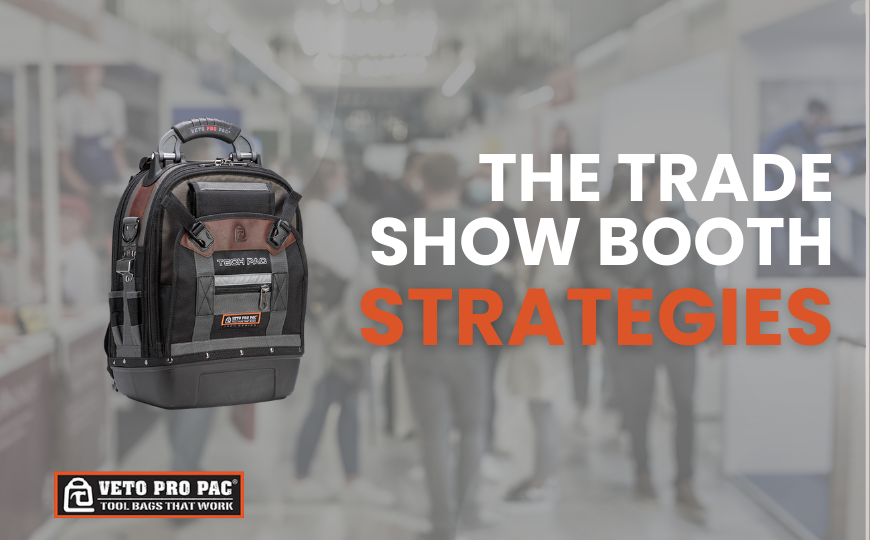
Position your most visually impressive or specialized tool bag at eye level as the booth anchor. This isn’t your daily driver—it’s your showcase piece. For Veto Pro Pac exhibitors, this typically means a fully-loaded Tech Pac Backpack Tool Bag arranged to display maximum organization.
What makes an effective attention magnet:
Open one side completely to reveal interior organization. Attendees need to see the system, not just the exterior. Elastic loops filled with premium tools, labeled compartments, and color-coded zones create visual interest that stops foot traffic.
Lighting matters significantly. A small LED strip or spotlight focused on the open bag interior makes tools visible from 15 feet away. Most convention center lighting is terrible—supplement it. The investment is $30 and dramatically increases visibility.
Pair the bag with a simple question placard: “How much time do you waste looking for tools?” or “What does disorganization cost your business?” This converts visual interest into cognitive engagement. Prospects who stop to consider the question are primed for conversation about efficiency solutions.
Tier 2: The Hands-On Experience (Table Display)
Position a second bag—ideally your actual working setup—at table height where prospects can touch and examine it. This tactile layer converts lookers into qualified leads.
Hands-on engagement strategy:
Invite attendees explicitly: “Go ahead and pick it up” or “Feel free to check out the organization.” Permission dramatically increases interaction rates. Most people hesitate to touch display items without invitation.
Keep this bag partially packed with real tools, including visible wear. Prospects connect with authenticity, not showroom perfection. A bag that’s clearly been on job sites for two years demonstrates durability far better than pristine merchandise.
Have a specific story ready for this bag: “This is my actual commercial service bag. It’s been in and out of mechanical rooms for four years, 200+ jobs. Notice the zippers still work perfectly—that’s why we specify YKK hardware.” Concrete details build credibility exponentially more than generic claims.
Tier 3: The Specialization Showcase (Floor Level)
Use floor space for specialty bags that demonstrate your service range. This tier shows capability breadth while keeping primary displays uncluttered.
For contractors serving multiple sectors, this might include: emergency response bag (storm work), confined space entry bag (industrial), testing and commissioning bag (new construction). Each bag represents a revenue stream and conversation starter for different prospect types.
Label each specialty clearly: “Hospital Emergency Power Testing Kit” or “Data Center Hot Work Bag.” Specificity attracts the right prospects. A facility manager responsible for data centers will stop to examine your clean-room-compatible tool setup, self-identifying their needs.
Differentiation Through Organization: Standing Out in Crowded Exhibits
Every electrical contractor at the show carries tools. Few demonstrate mastery of organization systems. This gap represents your differentiation opportunity.
Create contrast through comparison displays:
Set up a “before and after” comparison that resonates immediately. One side shows a generic tool tote with tangled cables and loose tools (the industry norm). The other side displays your Veto Pro Pac system with everything accessible within seconds. Add a timer prop: “Locate wire strippers: Disorganized bag = 47 seconds average. Organized system = 3 seconds.”
This visual comparison does heavy lifting. Prospects see their current pain point (the disorganized bag they probably own) next to the solution (your professional system). The implicit message: hiring you means working with someone who optimizes everything, not just tool storage.
Demonstrate workflow efficiency, not just aesthetics:
Most booth displays focus on appearance. Shift focus to function. Arrange your tool bag to show task-based organization: “Splicing Zone” with all termination tools together, “Testing Zone” with meters and leads, “Quick Access” pocket with highest-frequency items.
Walk prospects through a common scenario: “Service call comes in—breaker won’t reset. Here’s exactly what I grab in 15 seconds: meter, test leads, screwdriver set, flashlight, spare breaker. Everything’s in the Testing Zone. No searching, no delays, no frustrated customer waiting while I dig through my bag.”
This scenario-based demonstration makes abstract efficiency concepts concrete. Prospects mentally calculate how much time their current contractors waste on-site fumbling with disorganized equipment.
The ROI Conversation Starter: Making Tool Bags About Business Value
Smart exhibitors pivot from products to business impact quickly. Your tool bag display facilitates this shift when positioned correctly.
Quantify the efficiency gain:
Create a simple ROI placard visible near your display: “15 service calls per week. 5 minutes saved per call through better tool organization. = 3,750 minutes annually = 62.5 billable hours recovered = $6,875 additional revenue (at $110/hr rate).”
These calculations resonate with business owners and facility managers thinking about operational efficiency. You’re speaking their language—cost reduction and productivity—using tool organization as the entry point.
Adjust the numbers to match your audience. For facility maintenance directors: “Your four-person electrical team loses 20 minutes daily searching for tools. That’s 347 hours annually at $45/hour loaded labor cost = $15,615 wasted. Professional tool organization recovers this immediately.”
Position yourself as an efficiency consultant, not just contractor:
The most successful trade show exhibitors shift positioning from “we do electrical work” (commodity) to “we eliminate inefficiency in facility operations” (valuable service). Your tool bag display provides tangible proof you optimize systems.
When prospects express interest in your organization, respond with: “Tool efficiency is just one example. We apply the same systematic approach to your electrical infrastructure. Downtime costs you thousands per hour—we eliminate it through proactive planning and rapid response capability.”
This elevates the conversation from comparing hourly rates (race to the bottom) to discussing operational value (differentiated positioning). Prospects willing to pay premium rates for optimized service self-identify through interest in your systems.
Booth Layout That Converts Traffic to Conversations
Tool bag displays work within larger booth strategy. Poor layout undermines even excellent displays.
The engagement funnel approach:
Position your attention-magnet display at the booth entrance angle that captures passing traffic peripheral vision. Research shows attendees scan booths at 45-degree angles while walking aisles. Your eye-level display should target this sightline.
Keep the front third of your booth open. Never position tables or displays blocking entrance. Psychological studies consistently show people avoid entering spaces that feel cluttered or confined. An open invitation zone with clear walkways dramatically increases engagement.
Position yourself (the contractor) at mid-booth depth, not at the entrance. Aggressive positioning where you’re immediately in attendees’ faces reduces approach rates by 40-60%. Stand back far enough that prospects can examine displays before committing to conversation.
The conversation zone:
Create a natural gathering area around your hands-on display (Tier 2). Have stools or high-top table creating a “workshop” feel rather than formal sales counter. This lowers psychological barriers. Prospects are more willing to spend time in spaces that feel collaborative rather than transactional.
Keep business cards, literature, and contact forms easily accessible but not prominently displayed. Lead with value demonstration, not collateral. You want conversations about their needs, not people grabbing a brochure and walking away.
Have a tablet or laptop positioned showing project photos, but don’t actively run video loops. Passive video displays reduce personal engagement as attendees watch screens instead of talking to you. Activate project visuals during conversations when relevant.
Common Trade Show Display Mistakes That Kill Lead Generation
Learning from widespread exhibitor failures prevents wasting your investment.
Mistake #1: The Fortress Configuration
Contractors nervous about trade show environments often build physical barriers—tables forming U-shapes, bags stacked creating walls, prominent signage blocking sightlines. This defensive posture signals insecurity and discourages approach.
Solution: Keep perimeter 70% open. Create visual interest that pulls people in rather than barriers that keep them out. Confidence attracts prospects; anxiety repels them.
Mistake #2: The Museum Mentality
Treating tool bags as untouchable display pieces behind ropes or on high pedestals. This creates distance between your capabilities and prospect experience.
Solution: Encourage touching. “Check out the organization system” or “Pick it up—feel the quality” converts observers into engaged prospects. Tactile interaction increases booth time by 3-4x.
Mistake #3: The Generic Everything
Using contractor-branded bags without specialty differentiation. If every electrical contractor booth looks identical, prospects have no reason to remember yours specifically.
Solution: Find one distinctive element. Maybe it’s your color-coded organization system, maybe it’s specialty industrial bags, maybe it’s your documented tool tracking system. Own one specific positioning that competitors don’t claim.
Mistake #4: The Passive Salesperson
Standing silently while prospects examine displays, only speaking when directly questioned. This wastes engagement opportunities.
Solution: Develop observational conversation openers that don’t feel like sales pitches. “I noticed you stopped at the testing zone—are you dealing with troubleshooting calls regularly?” or “You’re the third person today who asked about that Megger—what kind of facilities do you maintain?” These questions open dialogue naturally.
Mistake #5: The Hard Close Attempt
Pushing for signed contracts or immediate commitments at the booth. Trade shows are lead generation venues, not closing environments.
Solution: Focus on qualification and follow-up permission. Get contact information, understand their needs, schedule post-show conversations. The goal is 50 qualified leads to follow up with, not 2 uncomfortable commitments extracted under pressure.
Post-Show Follow-Up: Converting Booth Engagement Into Revenue
Trade show ROI happens primarily after the event. Your tool bag display attracts attention; your follow-up converts it to business.
The 48-hour window:
Contact every qualified lead within 48 hours of show closing. After 72 hours, recall rates drop precipitously. Use specific references: “We talked about your hospital emergency power testing challenges—you mentioned the backup generator testing schedule.”
This specificity proves you weren’t just collecting business cards. You remember their situation, which dramatically improves response rates.
Reference the tool bag conversation:
Many contractors forget to connect post-show outreach back to booth interactions. Use your tool display as the reference point: “You asked about our organization systems for multi-site contractors. I wanted to share how we’ve helped similar operations reduce service call time by 15-20%.”
This callback reinforces the professional impression from the show while transitioning to business value discussion.
Offer immediate value:
Don’t lead follow-up with availability requests (“When can we schedule?”). Lead with value (“I put together three specific recommendations for your testing protocol challenges”). This frames you as consultant, not vendor.
Include photos of your booth tool displays in follow-up emails when relevant. Visual recall strengthens memory of the interaction and maintains the professionalism association.
ROI Analysis: Does Trade Show Investment Pay Off?
Smart contractors track trade show performance rigorously. Here’s realistic ROI analysis based on established electrical contracting trade shows.
Investment breakdown (regional electrical trade show):
- Booth space (10×10): $1,200-2,000
- Display materials and signage: $500-800
- Tool bags for display (if not owned): $600-1,200
- Show badge and registration: $400-600
- Travel and lodging (2 days): $800-1,200
- Staff time (2 days at $400/day): $800
Total investment: $4,300-6,600 for regional shows. National shows run 2-3x this amount.
Return calculation:
Average qualified leads generated: 40-60 (based on professional booth execution) Lead-to-customer conversion rate: 8-12% (electrical contracting typical) New customers from show: 3-7
Average first-year revenue per new commercial customer: $15,000-45,000 Total new revenue: $45,000-315,000
Even conservative scenarios (3 customers @ $15k each = $45,000 revenue) generate 7-10x ROI on show investment. Strong execution (7 customers @ $30k each = $210,000) produces 30x+ returns.
The compounding factor:
These calculations only account for first-year revenue. Commercial customers often provide recurring business for 5-10 years. A facility management contract acquired at a trade show might generate $200,000+ total lifetime value.
This makes show investment a no-brainer for contractors with capacity to handle new commercial work. The challenge isn’t ROI—it’s executing professional booth strategy that captures attention in crowded exhibit halls.
Tool Bag Display Strategy FAQs
How many tool bags should I display at a trade show booth?
Three is optimal for 10×10 booths: one eye-level showcase, one hands-on demo, one specialty on floor. More than four bags creates clutter and dilutes focus. Less than two appears under-equipped. The goal is demonstrating organization systems and capability range without overwhelming visual processing.
Should I display my actual work bags or buy new ones for shows?
Display actual working bags with visible wear. Authenticity builds more credibility than showroom-new equipment. Prospects connect with real-world durability, not artificial perfection. Clean and organize thoroughly, but don’t hide the fact these bags work daily on job sites.
What if competitors at the show use the same tool bag brand?
Differentiate through organization systems and specialization focus, not equipment brand. Two contractors displaying Veto Pro Pac bags can look completely different based on how they present workflow efficiency, target market specialization, and capability demonstration. Your positioning matters more than brand exclusivity.
How do I handle prospects who just want to talk about tools rather than services?
Use tool discussions as bridge to capability conversations. “The reason we invest in professional tool organization is the same reason clients hire us for critical infrastructure—we eliminate downtime through systematic approach. Tell me about your biggest electrical challenges.” Redirect gently from product fascination to business problem-solving.
Should I give away promotional items at my booth?
Only if they reinforce your positioning. Generic stress balls or cheap pens dilute a professional image. If you use promotional items, make them useful and quality: professional-grade flashlights branded with your company, or laminated reference cards for electrical codes. The promo should signal quality, not just distribute logos.
How many staff should work the booth?
Two people for 10×10 booths. One actively engages in approaching prospects, one handles deeper conversations with qualified leads. Solo operation forces you to choose between greeting new traffic and completing existing conversations—you lose opportunities either way. Three or more in small booths creates intimidating crowd that discourages approach.
Your tool bag display is a competitive advantage hiding in plain sight. Most contractors treat booths as an obligation rather than an investment opportunity—they show up with minimal effort and wonder why trade shows don’t generate leads. Professional presentation backed by strategic positioning converts exhibit space into your most productive sales channel.
Start with organization systems you already use daily. Your working tool setup, properly presented, demonstrates capability more powerfully than any brochure. The contractors generating 50+ qualified leads aren’t doing magical things—they’re executing a systematic booth strategy that positions tools as proof of professional operations.
The booth space you’re considering for next quarter’s show? It’s not an expense—it’s an investment generating 10-30x returns when executed professionally. Your tool bags already do the work. Now make them work as marketing assets.