
 Tool bags
 Tool Storage
 Made in USA
 Tool Bags By Trade
 Everyday Carry
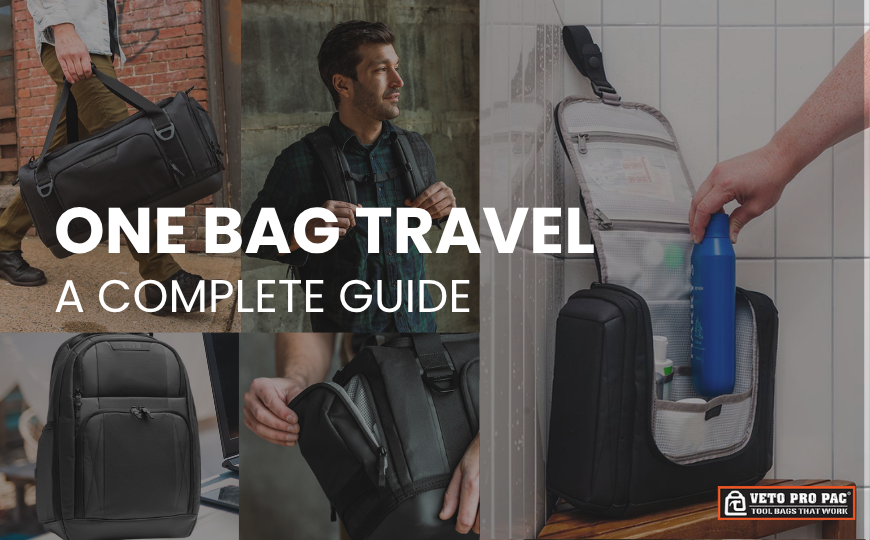
There’s a joke that there’s a Reddit community for everything. Well, it’s less of a joke and more just a fact of life, and if you have even a trace amount of interest in travel, then you’ve probably come across numerous subreddits associated with different travel philosophies like r/SoloTravel, r/Shoestring, and our favorite r/Onebagis no exception. Once you get into the one bag travel flow, it’s hard to go back to dragging four bags through the airport.
What is One Bag Travel?
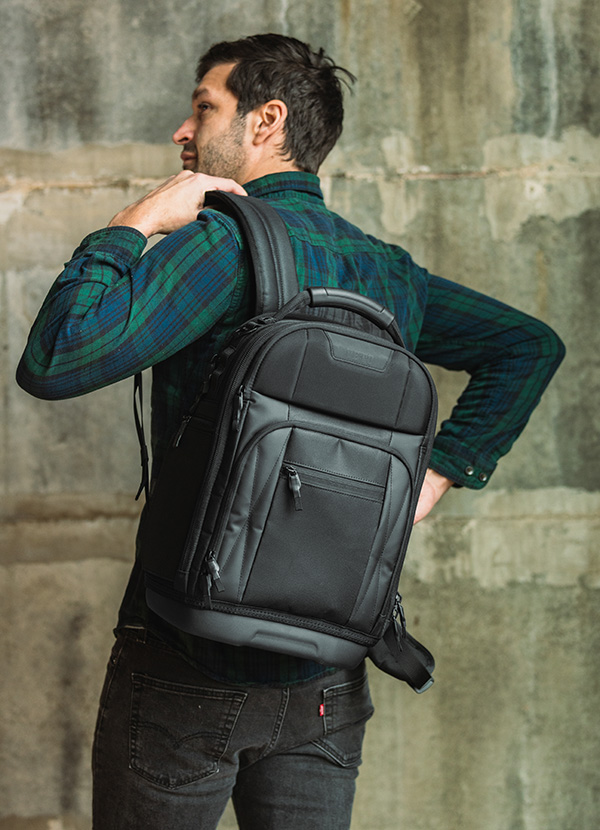
One bag travel means fitting everything you need for a trip into a single piece of luggage that you carry on with you. One bag, carried onto the plane, lived out of for the duration of the trip.
It’s often confused with carry-on-only travel, but there’s a real distinction. Carry-on-only is a rule-based approach where you pack everything you want within the airline’s carry-on dimensions.
Most dedicated one-baggers use a backpack in the 20–40 liter range. Some use a duffel. A few use a small rolling carry-on. The format is less of a concern than the main philosophy: everything you need fits into that one bag, and that bag moves with you the entire trip.
There are real tangible benefits:
- You never wait at baggage claim. On a two-hour flight, skipping baggage claim can literally cut your airport time in half.
- You never pay for checked luggage. Airlines have pushed checked-bag fees into the $40–$75 range per direction. One bag travel quietly saves hundreds of dollars a year for frequent travelers.
- Your bag can’t get lost. Mishandled luggage rates went up sharply post-pandemic and haven’t fully recovered. If your bag is in the overhead above your seat, it cannot end up in Johannesburg while you’re in Jakarta.
- You can actually move. Whether it’s cobblestone streets, three flights of stairs up to a walk-up rental, a train platform with a 90-second transfer window, or a crowded bus in a city where nobody owns a car, a single backpack or compact bag slung over your shoulder absolutely gives you unparalleled mobility.
What Starter Bag Should You Choose?
While the bag is less important than the mindset, that doesn’t mean you should disregard it entirely. In fact, getting the bag wrong can make or break your trip.
Here’s what matters, roughly in order of importance.
Size: 20L to 40L, and Smaller Is Often Better
Most one-bag travelers land somewhere between 20 and 40 liters. Beyond 40L, you’re carrying a small-suitcase volume on your back, which defeats the mobility advantage. Under 20L, you’re fighting the bag every day.
A good rule of thumb:
- 20–25L works for short trips (two to four days), warm-weather destinations, or travelers who’ve already dialed in their packing list. It also doubles easily as a daily commuter pack when you’re home.
- 25–35L is the generalist zone — enough for a week or more if you pack thoughtfully, still small enough to sling under an airline seat if you need to.
- 35–40L is for longer trips, colder destinations where clothes bulk up, or travelers who want to carry a bit more gear (a bigger camera kit, multiple pairs of shoes, and so on).
One more thing to know: international airlines have gotten stricter on carry-on weight since 2020. Many European and Asian carriers now cap free carry-on weight at 7 kg (about 15 lbs), down from 10 kg pre-pandemic. Budget airlines enforce this aggressively, and being over means either paying a fee at the gate or watching them check your bag. If you fly internationally — especially on budget carriers — weight is now a harder constraint than volume. A 40L bag you can fill to 20 lbs isn’t actually useful on a 7kg airline. Factor this in before you pick a size.
Durability
This is where people cheap out when looking for budget options. If you’re interested in one bag travel, then you’re probably someone who veers more towards minimalism and frugality. Those are great mindsets to have, but don’t let your love for the budget option land you with a bag that gets a ripped zipper, a blown-out seam at the shoulder strap, and base that soaks through the moment you set it on wet pavement on the third trip.
A bag built for this kind of use should have, at minimum:
- A reinforced base that won’t wear through from being set down repeatedly
- Water-resistant outer fabric for when you’re caught in the rain
- Heavy-duty zippers (cheap zippers are the number one failure point on travel bags)
- Reinforced stitching at stress points: shoulder straps, handles, zipper anchors
- A warranty that reflects the brand’s actual confidence in the bag, not marketing copy
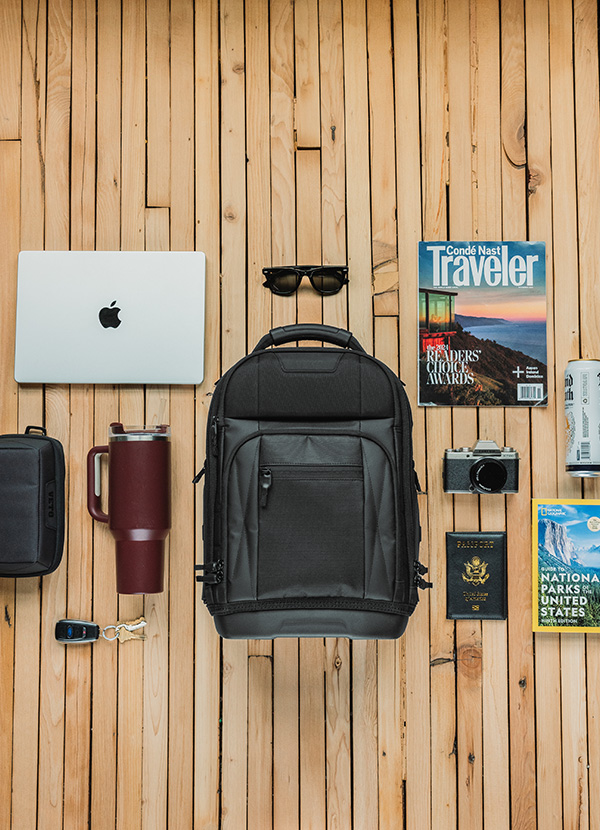
The NORWALK + 20L BACKPACK works within many airlines’ carry-on policies and is built for durability. For longer trips, try the NORWALK+ 40L DUFFEL
Organization
Surprisingly, this isn’t that important for one bagging. That’s because space is a higher priority, so bags with too much organization actually take away overall available space. You should rely on packing cubes and toiletry bags for organization.
Some things that are nice to have if you need it:
- A dedicated padded laptop/tablet compartment separate from the main clothes-and-stuff compartment. This is non-negotiable if you travel with a laptop.
- A quick-access pocket on the exterior for passport, phone, boarding pass, and wallet. Digging through your bag at every security checkpoint gets old fast.
- External water bottle pockets that actually fit a real bottle (a 32 oz Nalgene or a Stanley Quencher).
How to Pack for One Bag Travel
We recommend you check a carry-on packing list and customize it to fit your needs to start.
A few specific principles that separate experienced one-baggers from people stuffing a carry-on with everything they own:
Multi-use beats single-use, every time. A merino wool t-shirt you can hike in, sleep in, and wear to dinner beats three separate shirts for each activity. A convertible pant beats jeans plus hiking pants. A versatile sandal plus one pair of walking shoes beats five pairs of footwear.
The rule of threes (roughly). Three shirts, three pairs of socks, three pairs of underwear. One you’re wearing, one that’s clean, one that’s in the wash or drying. On longer trips, shift to four or five of each — but if you’re thinking about packing seven, you’re overpacking.
Roll, don’t fold (mostly). Rolling your clothes compresses them more efficiently than folding, wrinkles them less, and makes it easier to see what you have. Button-downs and structured pieces still benefit from folding flat; everything else rolls.
Use packing cubes. Packing cubes compress your clothes, keep categories separated, and let you pull out exactly what you need without disturbing the rest of the bag. Three small cubes is usually enough: one for tops, one for bottoms, one for socks and underwear. Compression cubes (with a second zipper that squeezes air out) are worth the small upcharge.
Weigh your bag before you leave. Target 15–20 pounds loaded, max — closer to 15 lbs if you fly international budget carriers with a 7kg cap. Anything heavier and you’ll feel it by the end of day one.
What Clothes to Bring for One-Bagging
If you pack wrong for a week, you’ll feel it for a week. A few specifics that experienced travelers converge on:
Merino Wool Is the Closest Thing to a Cheat Code
Brands like Smartwool, Icebreaker, Wool&, Unbound Merino, and Woolly are well-regarded in the one-bag community. Every serious one bag travel guide mentions merino, and there’s a reason. Merino wool resists odor for days. It dries fast after a sink wash. It insulates when it’s cold and breathes when it’s hot. It doesn’t itch like traditional wool. The only real downsides are cost (it’s not cheap) and wear (thin merino tees will develop holes faster than cotton).
Layer Instead of Bulking Up
For any trip that includes temperature variance, pack a layering system rather than a single heavy piece. A lightweight base layer, a mid-layer (fleece or thin puffy), and a shell jacket will cover everything from summer evenings to near-freezing mornings, while packing down smaller than a single winter coat would.
Pick a Color Palette That Mixes
If your bottoms are navy and black, your tops should work with both. Avoid the one loud-patterned piece that only matches one specific pair of pants. This sounds obvious, and yet most overpacking happens because people bring clothes that only work with one other specific item.
Related: nobody notices that you wore the same shirt twice. No one is going to accuse you of being an outfit repeater. The social cost of outfit repetition is entirely imaginary — and once you accept that, your packing list gets half as long.
Plan for Laundry
Most advise you to pack for five days, even on longer trips, because it’s assumed you’ll do laundry. Depending on where you’re travelling, you can either find a self-service laundromat, a drop-off laundry service, or just sink wash. If you have the space, you can bring along laundry sheets or just buy detergent when you get there.
For faster, more thorough washing on the road, many experienced one-baggers use the dry-bag laundry method: throw your clothes in a 10–20L dry bag, add water and a bit of detergent, seal it, and shake or let soak for 20–30 minutes. Rinse, wring, hang to dry. You get better cleaning than a sink wash without monopolizing a hotel bathroom, and the dry bag doubles as a waterproof layer for electronics in bad weather.
Shoes: One Pair, Maybe Two
Shoes are the single biggest space-and-weight item in most travelers’ bags, which is exactly why they deserve the hardest scrutiny.
Most one-baggers travel with one pair of shoes they wear on the plane, plus one secondary pair that packs small — typically a sandal (for beaches or shared showers), a flat-packing slip-on, or a minimalist running shoe.
Cons of One Bag Travel
Worth being honest about this. One bag travel is the right call for most trips, but not every trip:
- Extended cold-weather trips where you need a heavy winter coat, insulated boots, and thermal layers can push past what a single bag can reasonably hold.
- Formal events that require a suit, formal shoes, and specific accessories are doable one-bag but are honestly more comfortable with a second bag or garment carrier.
- Adventure trips with specialized gear — skiing, scuba, multi-day hiking — generally require their own dedicated luggage for the gear itself.
- Traveling with kids changes the math completely. One bag per person is a great target; one bag for the whole family usually isn’t realistic.
- Trips where you’re bringing gifts in or hauling purchases out — visiting family for the holidays, say — often justify a second bag you’d otherwise skip.
The mindset that experienced one-baggers converge on, across thousands of trips, is this: one bag travel is for people who can adapt. If you travel light, you will occasionally be caught without the thing you want. After enough travel experience, you learn to figure it out, you buy what you need, you borrow, you do without, you move on. That flexibility is part of what the system is actually training.
One Bag Travel Tips
A handful of things that experienced travelers wish someone had told them earlier:
- Leave 10–15% of your bag empty. A bag stuffed to capacity on day one is a disaster on day five. Leave room for souvenirs and purchases.
- Wear your bulkiest items on the plane.
- Keep a small “personal item” inside your bag. A packable daypack or sling (16L or smaller) that lives folded inside your main bag, then deploys as a daypack at your destination. This lets you leave the big bag at the hotel and still have something to carry water, a layer, and a camera on day trips.
- Use Lighterpack.com to build your list. It’s a free web tool that lets you log every item in your kit with weights, and the one-bag community uses it religiously. After each trip, review your list and note what you didn’t use, then pull those items from next trip’s pack. Every trip should make the list tighter.
- Bring a Heroclip or carabiner. A small clip attached to your bag handle lets you hang your pack off hotel hooks, bathroom stall doors, chair backs, and airplane tray tables — which means your bag isn’t sitting on floors of unknown cleanliness. Tiny tool, disproportionate quality-of-life improvement.
- Digitize what you can. Books go on a Kindle or phone. Travel documents go in Google Drive. Boarding passes go in Apple Wallet. A single phone replaces a lot of bulk.
But, above all, learn to relax. If you’re a reformed overpacker or worrywart, one bag travel is all about embracing minimalism and prioritizing the experiences you’ll gain from a trip over the things you bring.
Looking for more on packing smart and moving light? Check out the full Norwalk lineup and start building your one-bag system.