
 Tool bags
 Tool Storage
 Made in USA
 Tool Bags By Trade
 Everyday Carry
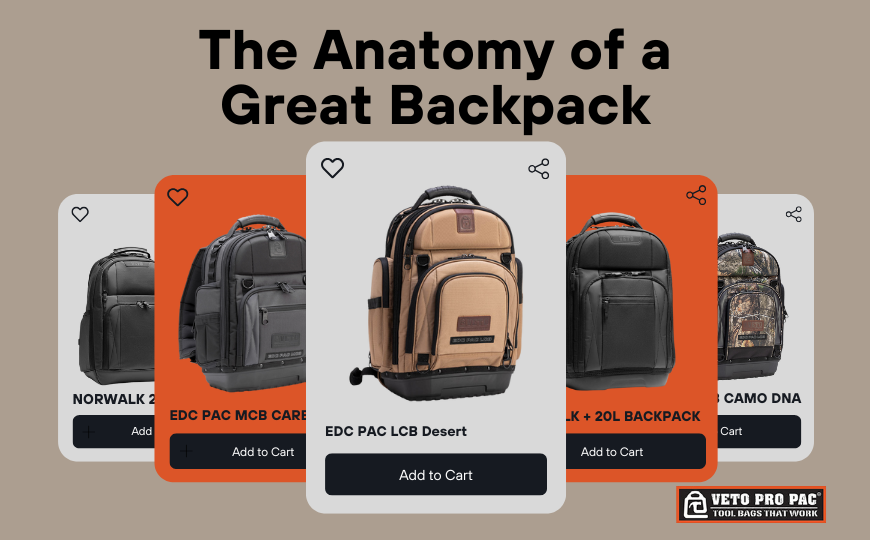
In an era defined by daily carry—the tech we transport, the tools we need, and the need for seamless transition between work, commute, and life—the backpack is no longer a simple sack with straps. It is a critical piece of engineering, an organizational system, and a piece of gear that directly impacts your productivity, comfort, and the safety of your expensive equipment.
Yet, walking into a store or browsing online reveals a vast chasm: bags that are indistinguishable garbage and bags that are built to last a decade. The price tags differ, but the true difference lies in The Anatomy.
This guide, written by gear experts who understand the demands of both the meticulous tradesman and the highly mobile commuter, will pull back the curtain on 7 fundamental design secrets that elevate a basic rucksack to an elite-level, high-performance carry system. By the end of this deep-dive, you will possess the knowledge to scrutinize any bag—understanding the precise backpack design features that justify a premium price and guarantee long-term durability.
Secret 1: Load Bearing & Comfort Systems
The greatest secret to a premium backpack isn’t found in its pockets; it’s found in its ability to defy gravity and move weight efficiently. Poorly designed bags pull back and down on your shoulders, leading to fatigue and back pain. An elite modern bag is a miniature suspension system.
The Suspension Triangle: Straps, Back Panel, and Frame
- Load Lifters (The Game Changer): These are small straps connecting the shoulder straps to the top of the bag. On cheap bags, they are purely aesthetic. On great bags, they are fully functional and critical. By cinching these straps, you pull the top of the bag closer to your body, shifting the weight’s center of gravity and transferring a portion of the load from your shoulders to your chest and back, dramatically improving weight distribution.
- The Back Panel and Airflow: The back panel must accomplish two contradictory goals: provide structure and allow ventilation. High-quality bags use structured, channeled EVA foam or tensioned mesh panels to create an airflow back panel. This not only adds protection for contents but minimizes the dreaded “sweaty back syndrome” that basic mesh or padded panels cause.
- Contoured & Dual-Density Foam: Look for straps that are noticeably contoured to the shape of the human torso. The ideal strap uses dual-density foam: firmer foam on the inside for structure and support, and softer foam on the outside for comfort against the body.
Stabilization Hardware
- A functional sternum strap prevents the shoulder straps from sliding apart, and a well-placed hip belt (even a removable one on commuter bags) can transfer up to 80% of the bag’s weight directly to your hips—a game-changer for heavy loads or long commutes.
Secret 2: Material Science & Shell Durability
The exterior shell is the bag’s armor. While many materials look similar, their performance under stress—specifically their abrasion resistance and water resistance rating—varies wildly.
The Denier Debate (And Why It Matters)
Denier (D) is a unit of measurement that describes the linear mass density of the fiber used in the fabric. Higher numbers mean thicker fibers and generally tougher material
| Material Type | Denier Range | Common Use & Strength Profile |
| Lightweight Nylon | 210D – 420D | Used for linings and lightweight daypacks. Offers minimal durability. |
| Standard Nylon/Polyester | 500D – 840D | Common for mid-range bags. Decent balance of weight and toughness. |
| Ballistic Nylon (Best for Commuter) | 1050D – 1680D | Highly abrasion resistant. Often used for military applications and premium commuter/tech bags. Excellent protection against sharp objects. |
| Cordura (Best for Tradesman) | 500D – 1000D | The industry standard for rugged jobsite durability. Known for exceptional tear strength and longevity. |
Secret 3: The Zipper & Fastener Ecosystem
The most common failure point of any bag is the zipper. A high-quality shell is useless if the zipper blows out.
The YKK Standard and Beyond
The global benchmark for quality is YKK zippers. If a bag doesn’t specify YKK, it’s a major red flag. But even within YKK, there are quality tiers:
- Standard Coil Zippers: Common, but can easily split if stressed.
- YKK RC (Racquet Coil) Zippers: A heavier-duty coil zipper specifically designed for bags. Much tougher and highly recommended.
- YKK AquaGuard (or Reverse Coil): Features a polyurethane film on the exterior that repels water and provides a smoother finish. Crucial for bags housing expensive tech, making them effective waterproof zippers.
- Hardware: ITW Nexus & Duraflex: The buckles, strap adjusters, and clips are often overlooked. Premium bags use branded, military-grade hardware from companies like ITW Nexus or Duraflex, ensuring clips won’t shatter when dropped in the cold or stressed under a heavy load.
Secret 4: Internal Organization Architecture
A modern bag must act as a protective digital vault and an efficient office on the go. This requires thoughtful organization, not just more pockets.
Laptop Suspension and Protection
The laptop sleeve suspension system is a non-negotiable feature for commuters. The sleeve must be padded and, crucially, suspended (or lifted) off the bottom of the bag. This prevents the delicate corners of your laptop from hitting the ground directly when the bag is dropped—a common point of failure.
The Admin and Quick-Access Zones
- Clamshell Opening: Allows the bag to fully open like a suitcase, providing easy, flat-lay access to all contents. This is a crucial backpack design feature for organization and security (especially at airports).
- Admin Compartment: A dedicated zone with small, structured pockets for pens, notebooks, small electronics, and business cards. Its efficiency dictates how fast you can find essentials.
- Hidden Quick-Access Pocket: A discreet pocket for phones, wallets, or passports, often placed on the back panel to sit against the wearer’s body for maximum anti-theft protection.
Secret 5: Base & Load Stability
The base of a backpack is where all weight is concentrated, and where it makes contact with the dirtiest, toughest surfaces.
- The Stand-Up Design: Premium tool bags and commuter backpacks are engineered to remain upright, empty or full. This stand-up backpack design is achieved through internal structural supports, often involving a perimeter frame or rigid EVA foam bottom. This stability prevents the bag from flopping over, keeps tools/contents accessible, and maintains professional appearance on the jobsite or in the office.
- Reinforced Seams: The seams connecting the base to the main body are highly stressed. Look for bases made of a single piece of tougher material (often a higher denier Ballistic Nylon or rubberized coating) that wraps up the sides slightly to protect against scuffing.
Secret 6: Modularity & External Integration
The modern gear ecosystem requires a bag that integrates smoothly with other systems, from rolling luggage to external carry tools.
- Luggage Pass-Through: A thick, durable webbing or fabric panel sewn horizontally into the back panel. This allows the bag to slide securely over the handle of a rolling suitcase, a feature that transforms air travel and heavy commutes.
- External Loops and Lashing Points: For tradesmen, external gear loops are essential for attaching hard hats, safety gear, or external ropes. For commuters, they can serve as attachment points for bike lights or carabiners. The construction (often MOLLE webbing or Hypalon) must be strong enough to bear significant weight.
- Water Bottle Pocket Design: A minor feature, but a tell-tale sign of good design. Elite bags feature deep, gusseted pockets made of stretch mesh or durable fabric that can securely hold a large Nalgene or insulated bottle without sacrificing internal space.
Secret 7: Craftsmanship & Stitching
The quality of construction is the final arbiter of durability. This is where premium manufacturers invest in skilled labor, while cheap bags cut corners.
- Bar Tack Stitching: This is a dense, tight zig-zag stitch used to reinforce areas of high stress—the top and bottom of every strap, the connection points for handles, and the base of external pockets. A premium bag will have bar tacking on every potential failure point.
- Bound Seams: On the inside of the bag, look for bound seams (fabric taped over the raw edges). This prevents fraying, improves water resistance, and proves a dedication to interior finishing that enhances long-term durability.
- Seam Tape: On fully waterproof bags, manufacturers will use a heat-sealed seam tape on all interior stitches to prevent any moisture from wicking through the needle holes. This is the difference between water resistance and true water proofness.
Your Next Investment: Elite Bags Built on These 7 Principles
If you’re in the market, brands like Veto Pro Pac nail a lot of this. Their backpacks are defined by their ability to protect valuable contents while supporting the wearer through the toughest commutes and workdays. The following bags are engineered with the precise durability and organization architecture detailed in this guide.
For the Commuter & Tech Professional (Sleek, Organized, Everyday Carry)
These bags are built for the urban professional who demands the rugged reliability of a tool bag, but in a refined form factor—featuring waterproof bases, trolley sleeves, and dedicated tech protection.
| Product | Design Highlight (Referencing the 7 Secrets) |
| NORWALK 20L Backpack | Secret 2 & 5: Recycled, water-resistant 600D waxed polyester with a rugged tarpaulin base. Secret 6: Trolley handle pass-through and unique zippered magnetic water bottle pockets (fits 40oz bottles). |
| NORWALK+ 20L Backpack | Secret 5: Upgraded durability with a highly durable, impact- and water-resistant thermoformed base for the ultimate stand-up design. Secret 1: Ergonomic over-molded grab handle and breathable micro-mesh back padding. |
For the Versatile Professional
Inheriting the DNA of Veto Pro Pac’s legendary tool bags, the EDC PAC line combines maximized organizational pocket count with an indestructible base and modularity for any daily carry scenario.
| Product | Design Highlight (Referencing the 7 Secrets) |
| EDC PAC LCB Desert & Carbon (27.5L) | Secret 5: The Ultimate Stand-Up Design. Features a waterproof, injection-molded polypropylene base for unmatched durability and stability. Secret 4: 36 interior and exterior pockets, multiple MOLLE loops, and a dedicated, padded laptop/tablet sleeve. |
| EDC PAC MCB Carbon (15L – TSA Approved) | Secret 5 & 2: Smaller, carry-on friendly size retaining the waterproof injection-molded base and rugged structural design. Secret 4: Semi-rigid top compartment specifically for protecting sunglasses/glasses, enhancing organization architecture. |
Ready to upgrade your carry? Check out Veto Pro Pac’s line at vetopropac.com. Your back—and your gear—will thank you.