
 Tool bags
 Tool Storage
 Made in USA
 Tool Bags By Trade
 Everyday Carry

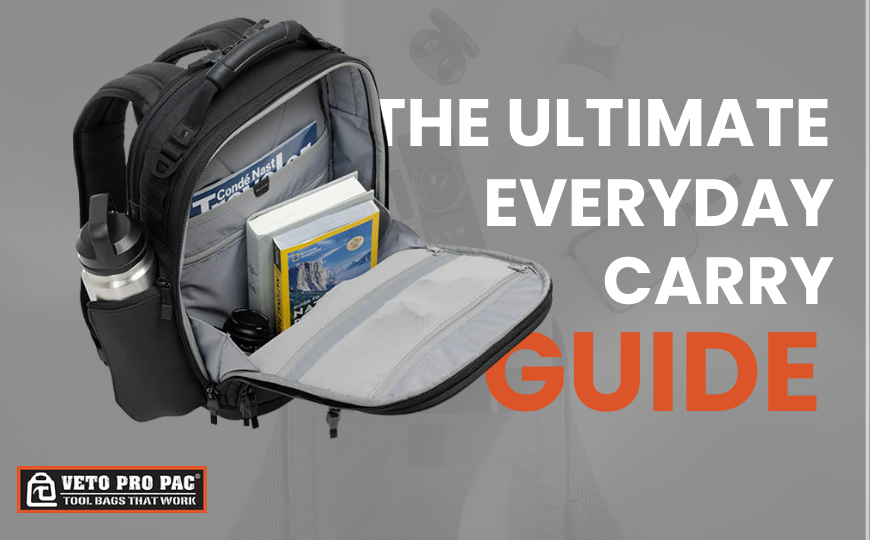
Everyday Carry, often shortened to EDC, has changed. If you’re someone who practices preparedness, you’ve probably seen this term floating around. EDC usually refers to essential items, such as phone, wallet, keys, first aid kit, tools, and protection, you carry in your pocket or bag everyday. What started as a niche concept centered on tools and preparedness has evolved into something broader and more relevant to modern life. Today, EDC is often used in conversations revolving around defeating brain rot, rescuing your brain from the algorithm, and staying offline. Whereas in the past, people would showcase their EDC featuring a variety of weapons, now you’re just as likely to see an EDC that contains an e-reader, MP3 player, a physical book, and a handheld gaming device.
In this ultimate guide to EDC, we explore the philosophy and foundation of EDC, essential items you might need, and the right bags that will get you through everyday.
What is Everyday Carry (EDC)?
At its simplest, Everyday Carry (EDC) refers to the items you carry with you every day. These can be obvious essentials, like a phone, watch, wallet, and keys, or more situational tools that solve small, recurring problems, such as flashlights, pocket knives, and portable chargers.
But in true practice, EDC isn’t merely about the items themselves. A thoughtful EDC setup:
- Supports your daily routine
- Reduces friction and distraction
- Transitions easily between environments
- Reflects how you actually live, not how you imagine you might need to live
Why is Everyday Carry (EDC) important?
Everyday Carry (EDC) provides practical advantages in everyday life. It ensures you have essential tools readily available, whether that means a compact multitool, a flashlight, a pen, or a wallet organized for quick access. This readiness reduces stress when unexpected situations arise, like a minor repair, a lost key, or navigating a new city. EDC also improves efficiency, allowing you to complete tasks without searching for items or relying on others. Beyond utility, EDC can be customized to match your routines, preferences, and style, offering a subtle form of self-expression.
From Gear Culture to Lifestyle Design
Much of early EDC culture focused on extremes: maximum durability, maximum preparedness, maximum redundancy. While that approach has its place, it often ignores context.
Most people don’t need to prepare for every scenario. They need to navigate busy days, unfamiliar cities, shifting schedules, and constant movement.
Modern EDC is less about carrying more and more about carrying better.
This shift mirrors broader design trends:
- Fewer objects, chosen intentionally
- Cleaner silhouettes and neutral palettes
- Products that blend into daily life rather than dominate it
What are the basic Everyday Carry (EDC) items?
If you peruse communities like r/edc, you’ll notice that the most popular EDC systems include some combination of the following:
If you frequent places where the community is less focused on handling any nuclear threat, you’re more likely to see an unplugged, brain-rot-free EDC like this:
- Phone or dumbphone
- Wallet
- Keys
- Watch
- MP3 player
- Power bank
- E-reader
- Notebook
- Writing tool
- Physical game (like a deck of cards) or a handheld gaming device
No matter what niche you fall into, the most important part of EDC is carrying the items most beneficial to you. If you need inspiration, you can check social media for EDC influencers, or you could join communities like r/EDC, r/everydaycarry, and r/dumphones.
How exactly should you carry everything?
This is debated. You have the minimalists who are very happy keeping everything in their very large pockets, which usually limits them to phone, wallet, keys, and maybe a pocketknife. For these people, carrying as little as possible is the goal.
However, for most people in the EDC community, preparedness for any situation is the name of the game, so some kind of bag is essential. The ideal EDC bag is durable and features proper organization, which means lots of slots and pockets to carry your gizmos. Any old backpack won’t do. If you’re thinking of just dumping everything in the cheapest backpack you can grab off the shelf, consider how annoying and frustrating it’ll be to have to constantly rummage around for what you need because everything is in one huge pocket. Consider how frequently you’ll need to replace the bag because sharp pens, the edge of notebooks, and your knife you just tossed in, poked a hole. Also, remember that comfort is essential to keeping your body healthy, and certain bags may not have proper weight distribution.
- Ideal for a variety of situations, including hiking, the gym, commuting, and travel.
- Ample space and durability.
- Water-resistant to keep your EDC loadout safe.
- Multiple compartments for easy organization.
- A good choice for those who want a minimalist, sleek design.
- This bag, available in several colors, is an offshoot of Veto Pro Pac’s popular TECH PAC.
- Built with durability and stability in mind.
- Features a molded base that keeps the bag upright
- Perfect for those looking for a stylish option that’s still functional.
What common mistakes do people make with Everyday Carry (EDC)?
Even well-intentioned EDC setups can drift off course.
Overpacking for unlikely scenarios: Since EDC first got its start in the prepper community, a common mistake people make is preparing for literally every scenario, no matter how unrealistic or improbable. This leads to EDC systems that are chaotic and back-aching.
Letting aesthetics override function: Design matters, but only when it supports use. Don’t buy backpacks or certain EDC items just because you envision a version of yourself that’s unlikely to manifest in reality.
Ignoring comfort and carry fatigue: If something is unpleasant to carry, it won’t last.
Failing to reassess: EDC should evolve as routines change.
EDC and Travel
Travel puts EDC systems to the test. Often, the EDC philosophy works well with Onebagging, as long as you embrace minimalism.
Airports, public transit, and unfamiliar environments demand gear that is efficient, legal, and adaptable. Items that work at home but fail under travel conditions often reveal themselves quickly.
Travel-oriented EDC prioritizes:
- Ease of access through security.
- Thoughtful organization.
- Compliance with local regulations.
- Compact, modular organization.
- Gear that doesn’t draw attention.
How to build an EDC Loadout That Fits Your Life?
This mostly depends on your individual needs and preferences. If you’re just starting, it’s important to start small as you assess what you actually need. Go over what you currently carry; the gaps in your carry will become obvious, or you’ll find that you’re carrying more than you need.
Then determine: What draws you to EDC? Is it rugged preparedness for any situation, or is it efficient carry for everyday activities? Are you looking to be a minimalist, or are you looking for something to keep you off your phone?
Another key thing to remember is quality over quantity. Make sure to pick high-quality gear that will keep you satisfied for years, versus cheap things you grabbed because you “need” them. Research thoroughly, which means reading and watching reviews.
From there, let real use guide future changes.
Remember, your EDC should reflect your real life, so make sure you approach it by looking for things beneficial to you. By following this guide, you’ll build something that will keep you prepared and ready for anything.